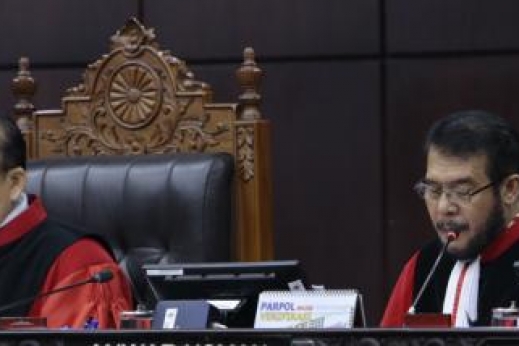
JAKARTA, Public Relations of the Constitutional Court—The Constitutional Court (MK) rejected the entire petition of the judicial review of Article 272 of the Criminal Procedure Code as well as Articles 12 and 65 of the Criminal Code. The Decision No. 84/PUU-XVI/2018 was read out by Chief Justice Anwar Usman, Monday (15/4/2019) in the Plenary Courtroom of the Constitutional Court.
The Petitioner, Century Bank convict Robert Tantular, challenged concursus. The norms in the articles, he believed, did not reflect a sense of legal justice and expediency because its enactment had caused the Petitioner to serve a criminal sentence exceeding regulations.
When reading the legal considerations, Deputy Justice Aswanto said that the implementation of Articles 63, 64, and 65 of the Criminal Code (KUHP) is a human rights protection mechanism. It especially applies for convicts so that criminal sentence by the judge does not exceed the maximum criminal sentence.
"Therefore, it is important for the Court to remind that when samenloop/concursus occurs, the public prosecutor must charge one in an indictment so that the convict is not sentenced exceeding the maximum sentence by the judge," he said.
The prosecution in one indictment by the public prosecutor, he said, in the context of a concursus is a necessity because the punishment system adopted by the Indonesian criminal law is that the accumulation of sentences cannot exceed the maximum sentence.
Justice Aswanto further explained that if the Court\'s consideration is related to the case argued by the Petitioner—the Petitioner\'s criminal case which was made in a separate indictment by the public prosecutor even though it was a concursus. That, according to the Court, if what is argued by the Petitioner is true and without the intention of the Court to assess the concrete case experienced by the Petitioner, the real problem is not the constitutionality of the norms of Articles 63, 64, and 65 of the Criminal Code, but the implementation of the norms of the a quo articles.
However, it is important for the Court, he asserted, that the prosecution and splitting of criminal cases in a concursus and continuous offense does not necessarily make the legal process violate human rights and contrary to the principle of fast, simple, and economical court. This is as long as the reason for the difficulty in carrying out one-time prosecution and indictment actually occurs because of technical difficulties in collecting evidence or other matters.
"It is also important to remember that at the end of the prosecution process and the court\'s decision, the criminal sentences shall not exceed the maximum mandated by Article 63, Article 64, and Article 65 of the Criminal Code. Therefore, it needs to be reaffirmed, especially for law enforcement officials, to really examine, both theoretically and substantially the practice that is the spirit desired by Article 63, Article 64, and Article 65 of the Criminal Code," he explained.
Single Offense
Justice Aswanto added that if in a concursus there has been a judge’s ruling and a concursus cannot be applied due to technical issues caused by matters that have been considered, the criminal offense shall lose its concursus nature.
Thus means, he said, the criminal offense is no longer a concursus but is a sustained offense. It can eventually be processed separately but the public prosecutor and judge must consider a sense of justice by imposing a criminal sentence not exceeding the maximum criminal sentence prescribed.
"Considering that based on all the legal considerations mentioned above, it is clear that both Article 272 of the Criminal Procedure Code and Article 63, Article 64, and Article 65 of the Criminal Code have no constitutionality issue against the 1945 Constitution, therefore, the Petitioner\'s argument is legally groundless in its entirety," he stressed. (Arif Satriantoro/LA/Yuniar Widiastuti)
Monday, April 15, 2019 | 18:25 WIB 209