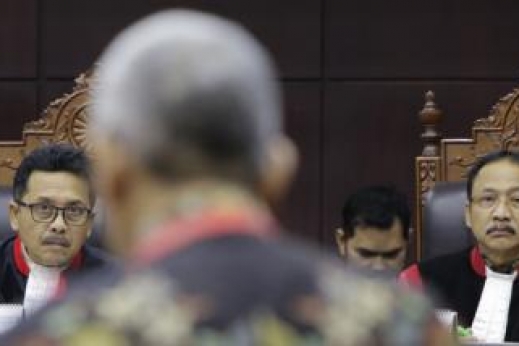
Plenary hearing to listen to the Government’s statement in the judicial review of Fiduciary Security Law, Thursday (11/4) in the Plenary Courtroom of the Constitutional Court. Photo by Humas MK/Ganie.
JAKARTA, Public Relations of the Constitutional Court—The Constitutional Court held a third judicial review hearing of Law No. 42 of 1999 on Fiducia Security in the Plenary Courtroom of the Constitutional Court on Thursday (11/4/2019). The case No. 18/PUU-XVII/2019 was petitioned by Aprilliani Dewi dan Suri Agung Prabowo. They argued that Article 15 paragraphs (1), (2), and (3) of the Fiduciary Law contradict Article 27 paragraph (1), Article 28D paragraph (1), Article 28H paragraph (4) and of the 1945 Constitution.
In the session led by Chief Justice Anwar Usman, Director of Litigation of the Ministry of Law and Human Rights Ardiansyah as legal counsel for President/the Government said that the fiduciary security certificate is an agreement made based on legally-founded trust and is peremptory. As for the legal losses outlined by the Petitioners in the case, according to the Government, is a civil problem caused by a dispute on material execution in a dispute. The Decision of the South Jakarta District Court on April 24, 2018 on Case No. 345/PDT.G/2018/PN.jkt.Sel, which granted the Plaintiff\'s claim (in this case the Petitioners in the a quo case), proved that there had been a civil dispute.
"So, the a quo article argued to have harmed the Petitioners is not classified as a constitutional loss. Therefore, the Petitioners must understand the basis of the binding agreement between the Petitioners and creditors," Ardiansyah explained. In addition, he added, actually the Petitioners\' argument was also a proposition of civil law with objects that could be calculated. So in this case, the a quo law cannot be reviewed because it is not related to constitutional loss.
Claim for Protection
In relation to the Decision of the South Jakarta District Court on Case No. 345/PDT.G/2018/PN.jkt.Sel., Ardiansyah said that the granting of the Plaintiff’s suit had given them the opportunity to claim legal protection, including legal certainty. “Therefore, in this case the Government is of the opinion that there has not been constitutional loss claimed by the Petitioners, and that this is a matter of norm implementation,” he explained.
Thus, Ardiansyah added, there is a legal guarantee of the activities of creditors and debtors to guarantee and help the community and business activities as well as provide convenience to stakeholders, including fiduciary providers to carry out business activities and fiduciary recipients in obtaining legal power in their certificates.
Legal Power
Related to the provision of Article 14 paragraph (3) of the Fiduciary Security Law along the phrase "fiduciary security", Ardiansyah explained that a fiduciary agreement involves collateral, where the fiduciary certificate arises from the necessity to record fiduciary security registration. Thus, the fiduciary registration office is obliged to issue the certificate, which gives it legal force as an authentic deed. The purpose is to protect both parties, the giver and recipient of legal fiduciary guarantees, and to bind both parties. "Fiduciary security is a material right and is not an individual [right] and fiduciary objects are generally movable assets, making it easier for creditors to move them if there is breach of trust," said Ardiansyah.
The Petitioners had previously argued that their car, a Toyota Alphard V Model 2.4 A/T 2004, had been seized by PT Astra Sedaya Finance (PT ASF). They had made a Multipurpose Financing Agreement to finance the purchase of the luxury car. In accordance with the agreement, he was required to pay the loan to PT ASF for Rp222,696,000 in 35-month installments starting November 18, 2016. In November 18, 2016 - July 18, 2017 the Petitioner had finished paying the installments. However, on November 10, 2017, PT ASF sent a representative to seize the car on the grounds of default. The Petitioner subsequently filed a letter of complaint regarding the seizure by PT ASF representative. However, it was not responded, until he received more mistreatments.
In response to the mistreatments, the Petitioner took a legal action by filing a civil suit to the South Jakarta District Court on April 24, 2018 in case No. 345/PDT.G/2018/PN.jkt.Sel. The court granted the Petitioner\'s claim by stating that PT ASF had committed an illegal act. However, on January 11, 2018, PT ASF once again seized the Petitioner\'s car in the presence of the police. The Petitioner considered that PT ASF had taken refuge behind the article reviewed in the a quo case even though, Suri Agung added, the decision of the South Jakarta District Court is higher than the a quo law. Thus, the Petitioner argued that there was no legal juridical reason for PT ASF to seize his car by face, including on the basis of the a quo article.
Before concluding the session, Chief Justice Anwar reminded that the next session is scheduled for Wednesday, April 24, 2019 at 11.00 WIB with to listen to the statement of experts for the Petitioner. (Sri Pujianti/LA/Yuniar Widiastuti)
Thursday, April 11, 2019 | 18:15 WIB 175