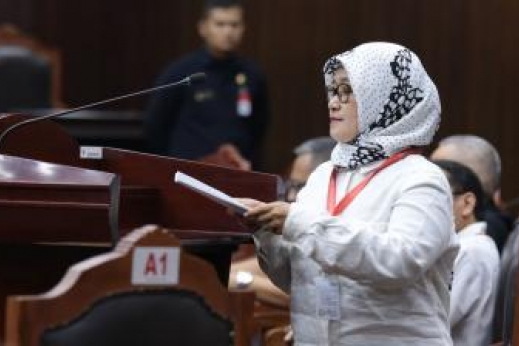
Head of Ministry of Trade’s Legal Bureau Sri Hariyati giving statement on behalf of the Government in the judicial review hearing of Article 4 paragraph (2) letter d of Law Number 7 of 2014 on Trade Wednesday (27/3) in the Courtroom of the Constitutional Court. Photo by Humas MK/Ifa.
JAKARTA, Public Relations of the Constitutional Court—Head of Ministry of Trade’s Legal Bureau Sri Hariyati denied the assumption that if education is privatized the state will avoid responsibility for the sector. This was conveyed in the judicial review hearing of Article 4 paragraph (2) letter d of Law Number 7 of 2014 on Trade on Wednesday (27/3/2019)in the Plenary Courtroom of the Constitutional Court.
The judicial review petition of the Trade Law was filed by Reza Aldo Agusta, a semester 4 student of Unika Atmajaya Yogyakarta. He challenged Article 4 paragraph (2) letter d of the Trade Law that reads, “In addition to the scope of the arrangements referred to in paragraph (1), also regulated tradable services including: d. Educational services.” When educational services were seen as commodity, it would lead to the increase of education costs. In addition, he argued that the objective of education would change from educating to profit-making. According to the Petitioner, the purpose of education in Indonesia was to educate the nation, as stated in the fourth paragraph of the Preamble of the 1945 Constitution.
As a representative of the Government, Sri stated that the state plays a role in the formulation of policies related to provision, standardization, accreditation, and other matters in the education sector. On the other hand, the Government also allocates 20% of the state budget for education. In order to improve the quality of education in Indonesia, she said, the Government also provides operational funding assistance, for example, operational assistance for schools, state universities, and private tertiary education programs.
Sri asserted that the Government and the House in 2010 through Law Number 2 of 2010 on the 2010 Revised State Budget (APBN-P) stipulates that part of the budget allocation for education in APBN-P be used as the National Education Development Fund (DPPN), managed through an endowment management mechanism by a public services body.
“Likewise, the Ministry of Finance through the Regulation of the Ministry of Finance No. 252/PMK.01/2011 on December 28, 2011 stipulated that the management of the Institute for Educational Fund Management (LPDP) as a non-echelon institution that directly answer to the Minister of Finance and is guided by policies stipulated by the LPDP Trustees Board, namely the Minister of Education and Culture, Minister of Finance, and Minister of Religious Affairs. The policy is a state effort to provide a budget for the implementation of the national education,” she affirmed in response to petition No. 16/PUU-XVII/2019.
The source of education funding at the macro level, said Sri, has been regulated in Article 31 of the 1945 Constitution, which mandates that the Central and Regional Governments be responsible for providing education budgets. That is, education funding cannot be separated from state financial policies.
On the other hand, Sri did not deny that the article being reviewed classifies education as a type of tradable service. However, there are still restrictive regulatory provisions. "Those restrictions are regulated through regulations in each service sector. For education services, clearer regulations have been arranged in the National Education System Law and the Higher Education Law," she said.
Sri also stated that education services are one component of the national education system and are not the entire national education system itself. The concept of the national education system is clearly regulated in the National Education System Law and the Higher Education Law. It is inappropriate if the inclusion of educational services in Article 4 paragraph (2) letter d of the Trade Law is claimed to be dualism in the education system. "The Trade Law does not regulate the national education system at all, so it does not create dualism in the national education system," she said.
In relation to education services can be provided by the private sector, Sri said, it is quasi-public goods as it aims to increase public access to public goods that cannot be provided by the Government, for example, because of limited education budget to provide a more optimal education.
Traded Services
Sri also explained the history of the classification of education as tradable services. Indonesia, through Law No. 7 of 1994 on the Ratification of the Agreement of the Establishment of the World Trade Organization, has approved the agreement on the Establishment of the World Trade Organization. "With the enactment of the law, the WTO provisions, one of which regulates services (General Agreement on Trade in Services/GATS), must be implemented. Education is also included in trade services," she said.
Educational services, Sri explained, are one of 12 service sectors in GATS. The GATS agreement binds WTO members to eliminate trade and investment barriers in the services sector including education services.
"To encourage trade of services, the Government provides operating permits to the private sector/general public to manage some [of the services]. Meanwhile, the Government can deregulate the public service sector in order to strengthen commitments in the relevant service trade sector based on GATS," she said. (Arif Satriantoro/LA/Yuniar Widiastuti)
Wednesday, March 27, 2019 | 18:48 WIB 240