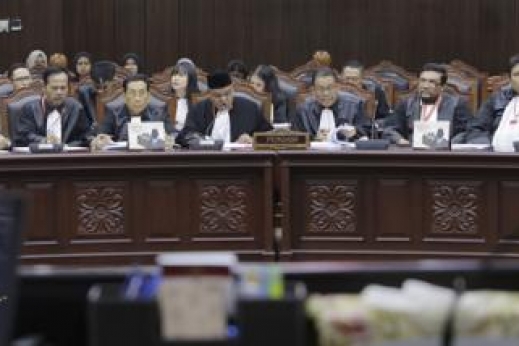
Panel petition revision hearing of the judicial review of the Election Law, Wednesday (27/3) in the Plenary Courtroom of the Constitutional Court. Photo by Humas MK/Ganie.
JAKARTA, Public Relations of the Constitutional Court—The Constitutional Court (MK) held the petition revision hearing of the judicial review of Article 458 paragraph (6) of Law No. 7 of 2017 on General Elections on Wednesday (27/3/2019). The hearing of case No. 21/PUU-XVII/2019 was to hear the revision to the petition.
The petition was filed by advocate Petrus Bala Pattyona. Article 458 paragraph (6) of the Election Law regulates that election organizers who are reported must come alone and cannot authorize others in the hearing of the Election Organizer Ethics Council (DKPP) and cannot authorize others. The Petitioner said that it had made him as advocate not to be able to perform his job, to have lost his right to compensation or work or income and fair treatment and the right to recognition, guarantee, protection, and fair legal certainty in exercising rights and obligations as a legal counsel.
The Petitioner hoped that an interpretation by the Court will stop the loss and that advocates are no longer restricted by limitation in Article 458 paragraph (6) of the Election Law because of the phrase ‘cannot authorize others’ have harmed the him.
In the session, Petrus said that he had improved the legal standing. He argued that the constitutional loss that he claimed is specific and there is clear causal relationship between his loss and the enactment of the law. “There is possibility that if the petition is granted, the constitutional loss will no longer exist,” he stressed.
He had also removed the statement indicating his status as a taxpayer. He also argued that the phrase “cannot authorize others” is contrary to articles in the 1945 Constitution. “It is contrary to the Advocate Law Articles 1, 2, 15, 18, 21, as well as the Law on Legal Aid, that is, Law Number 16 of 2011,” he explained.
Petrus then stressed that the DKPP ethics hearing can be classified as a general hearing that has a legal aspect. He quoted Jimly Asshiddiqie that the DKPP hearing is not merely ethical, but semi-legal, which he viewed as quasi-hearing in ethics. “[Jimly] elaborated on this in his writing or in his book on DKPP procedural law, which explains that DKPP proceedings applies judicial principles, such as audi et alteram partem and independence,” he affirmed.
Petrus further said that the DKPP ethical hearing, according to Jimly Asshiddiqie, is not merely of ethics, but also law. "This is signified by the characteristics of a good court, such as criminal, civil, or state administration. Because one\'s ethical violation is proven through legal procedure or due process of law.” (Arif Satriantoro/LA/Yuniar Widiastuti)
Wednesday, March 27, 2019 | 18:26 WIB 153