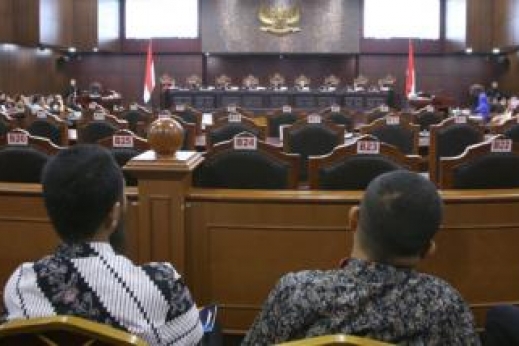
Ruling hearing of the judicial review of the Election Law, Wednesday (13/3) in the Plenary Courtroom of the Constitutional Court. Photo by Humas MK/Ganie.
JAKARTA, Public Relations of the Constitutional Court—The Constitutional Court rejected the entire judicial review petition of Law No. 7 of 2017 on General Elections. The Decision No. 10/PUU-XVII/2019 was read by the Constitutional Justices on Wednesday (13/3/2019) in the Plenary Courtroom of the Constitutional Court. The material review of Article 299 paragraph (1) and Article 448 paragraph (2) letter c of the Election Law was petitioned by law students of As-Sayfiiyah Islam University Ahmad Syauqi, Ammar Saifullah, Taufiqurrahman Arief, Khairul Hadi, Yun Frida Isnaini, and Zhillan Zhalilan.
The Petitioners argued about violation of their constitutional rights due to the lack of transparency in the work and results of the survey team. In addition, they argued that their constitutional rights had been violated due to the absence of campaign period for incumbent candidates. The Petitioners had stated that before the Election Law came into effect, if incumbent presidential and vice presidential candidates participated in the presidential election (Pilpres), they must take a leave of absence, that even if they still had protocol rights, they would have limited use of state facilities. Article 6 of Law No. 42 of 2008 on the Election of the President and Vice President (Pilpres) even stipulates that state officials who run for the election must resign from their positions. However, in the implementation of the 2019 Presidential Election based on the Election Law, such an obligation is not regulated. This, according to the Petitioners, may cause problems in the campaign for incumbents.
In the opinion of the Court read out by Constitutional Justice I Dewa Gede Palguna, the Court is of the opinion that the Petitioners\' arguments are irrational. That is because Article 299 Paragraph (1) of the Election Law expressly guarantees that, as presidential and vice presidential candidates, the right the incumbents to carry out a campaign is not reduced at all should they run again. Palguna stressed that it will be contrary to the spirit of the General Elections and the 1945 Constitution if the incumbent president and/or vice president who wants to run again are not given the right to campaign.
“"Because, if this is done, it means that there is discrimination against incumbent presidential and vice presidential candidates and other presidential and vice presidential candidates participating in the General Elections. The issue whether the right will be used or not is entirely in the hands of the person concerned. However, due to their current positions, incumbent candidates are imposed with restrictions to avoid position abuse when exercising their right to campaign,” Justice Palguna explained.
On violation of the public’s right to know as argued by the Petitioners, the Court is of the opinion that the right of presidential and vice presidential candidates to campaign is in fact guaranteed by Article 299 Paragraph (1) of the Election Law. Therefore, Justice Palguna added, the article does not violate the intended right because the public does not lose their opportunity to listen to the visions, missions, and programs of incumbent presidential and/or vice-presidential candidates.
“After all, finding out the vision, mission, and program of presidential -vice presidential candidate pairs, including [incumbents], is not limited to face-to-face campaigns (as implied by the Petitioners\' arguments),” he said.
Transparency
Justice Palguna also stressed the importance of transparency of polls. In other words, lack of transparency or lack of scientific approach in its methodology does not necessarily make a survey unconstitutional because it is an academic issue. So, the accountability of the survey is academic.
In case of violation of academic principles by a survey, he asserted, “[The survey] will lose its academic credibility and, as a logical consequence, it will not receive public trust sociologically. Here is the importance of pollsters being ethically overseen by a survey agency association.”
Based on all the legal considerations above, the Court is of the opinion that the entirety of the Petitioners’ argument is groundless according to law. (Lulu Anjarsari/Yuniar Widiastuti)
Wednesday, March 13, 2019 | 18:43 WIB 197