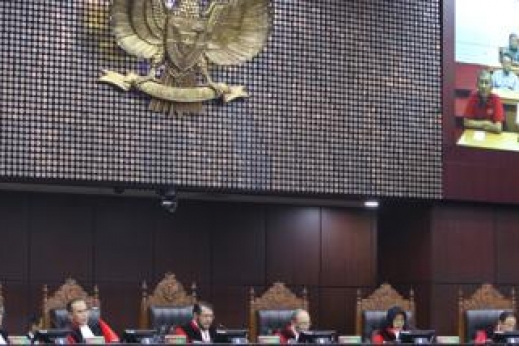
Plenary ruling hearing of the judicial review of the Manpower Law, Wednesday (27/2) in the Constitutional Court. Photo by Humas MK/Ganie.
The Constitutional Court rejected the judicial review of Article 167 paragraph (3) of Law No. 13/2003 on Manpower on Wednesday (27/2/2019). The Court deemed the background of the petition unreasonable.
In case No. 100/PUU-XVI/2018, Chairperson of the Forum for Pensioners of Bank Negara Indonesia (FPP BNI) Martinus Nuroso had questioned Article 167 paragraph (3) of Law No. 13/2003 on Manpower. The a quo article reads, "If the employer has included the worker/laborer whose contributions/premiums paid by the employer and the worker/laborer, then that which is calculated with the severance pay shall be the pension whose contributions/premiums have been paid by the employer." The Petitioner had made various efforts along with FPP BNI to obtain underpaid severance pay. He claimed that BNI Management, through its internal regulations, had unilaterally interpreted Article 167 paragraph (3) of the Manpower Law by not considering the elucidation to the article. The elucidation to Article 167 paragraph (3) explicitly explained the calculation example of the pay that should have been received by the Petitioner as a BNI pensioner. Therefore, the right of the Petitioner to obtain severance pay in the appropriate amount was not fulfilled.
In the legal consideration read out by Constitutional Justice Arief Hidayat, the Court deemed the petition an implementation issue of the norm. This is because Article 167 paragraph (3) of the Manpower Law was not implemented according to its elucidation. The Petitioner also had admitted as such, as explicitly stated in the petition. The Court in the preliminary hearing on December 18, 2018 had advised that the Petitioner elaborate clearly a different background to re-filing the petition as the Court had passed Decision No. 46/PUU-XVI/2018 on a similar case, also petitioned by the same Petitioner.
“The Court had examined the Petitioner’s petition carefully and thoroughly, and [found that] the distinction from previous judicial review petitions that had been decided by the Court [as stated by the Petitioner] only lies on the addition to the reference, but substantively the Petitioner had not elaborate clearly the reasons indicating the distinction in question,” he said.
Therefore, Justice Arief added, substantially there was not any new constitutional reason that compelled the Court to change its stance on the constitutionality of the article being reviewed. This means that the petition’s rationale is legally groundless. (Arif Satriantoro/LA/Yuniar Widiastuti)
Wednesday, February 27, 2019 | 19:02 WIB 225