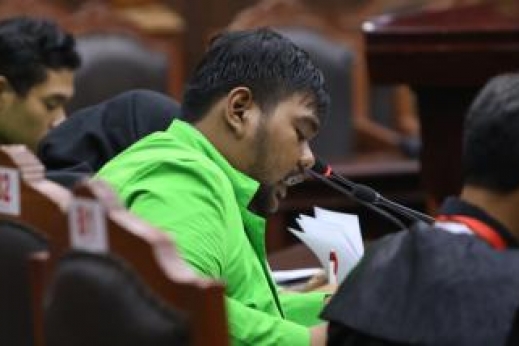
One of the Petitioners Ammar Saifullah delivering the subjects of the petition of the judicial review of the Election Law, Wednesday (20/2) in the Plenary Courtroom of the Constitutional Court. Photo by Humas MK/Aufa.
JAKARTA, Public Relations of the Constitutional Court—The Constitutional Court once again held the judicial review hearing of Law No. 7 of 2017 on General Elections in the Panel Courtroom of the Constitutional Court, Wednesday (20/2/19). The hearing of case No. 10/PUU-XVII/2019 was presided over by Constitutional Justice I Dewa Gede Palguna, accompanied by Constitutional Justices Wahiduddin Adams and Saldi Isra. Law students of As-Sayfiiyah Islam University Ahmad Syauqi, Ammar Saifullah, Taufiqurrahman Arief, Khairul Hadi, Yun Frida Isnaini, and Zhillan Zhalilan challenged Article 299 paragraph (1) and Article 448 paragraph (2) letter c of the Election Law.
In this revision session, one of the Petitioners Ammar Saifullah said that the petition had been revised, especially the constitutional loss suffered by the Petitioners due to the enactment of the Election Law. The Petitioners argued that, as students who had a stake in the implementation of elections, they paid intense attention to the 2019 legislative and presidential elections. In essence, the a quo norm gives presidential candidates the right to carry out a campaign.
"On that basis, there is the potential of loss of campaign rights for presidential candidates, which is related to the rights of the Petitioners as citizens to obtain information on the vision and mission of the incumbent presidential candidate pair," Ammar explained.
Ammar also said that with the enactment of the a quo norm, there is the potential of violation of the Petitioners\' constitutional rights with the lack of transparency in the work and results of the survey team. In the previous session, the Petitioners had stated that before the Election Law came into effect, if incumbent presidential and vice presidential candidates participated in the presidential election (Pilpres), they must take a leave of absence, that even if they still had protocol rights, they would have limited use of state facilities. Article 6 of Law No. 42 of 2008 on the Election of the President and Vice President (Pilpres) even stipulates that state officials who run for the election must resign from their positions. However, in the implementation of the 2019 Presidential Election based on the Election Law, such an obligation is not regulated. This, according to the Petitioners, may cause problems in the campaign for incumbents.
In addition, related to Article 448 paragraph (2) letter c of the Election Law, the Petitioners argued that the funding sources of electability survey of the presidential and vice presidential candidates should be explained so as not to cause issues. Therefore, the survey\'s methodology and funding sources of the incumbent candidate pair should be open to the public. Based on the argument, the Petitioners requested that the Constitutional Justices declare Article 299 paragraph (1) of the Election Law contrary to the 1945 Constitution and not legally binding insofar as the phrase “The President and Vice President have the right to conduct campaign” not be interpreted as “The President and Vice President have the right to conduct campaign outside of working days for incumbent president and vice president candidates.” Similarly, they requested that Article 448 paragraph (2) letter c not be interpreted “Public participation as referred to in paragraph (1) can be realized in the form of c. Election surveys or polls with the obligation to disclose sources of survey funding.” (Sri Pujianti/LA/Yuniar Widiastuti)
Wednesday, February 20, 2019 | 16:17 WIB 237