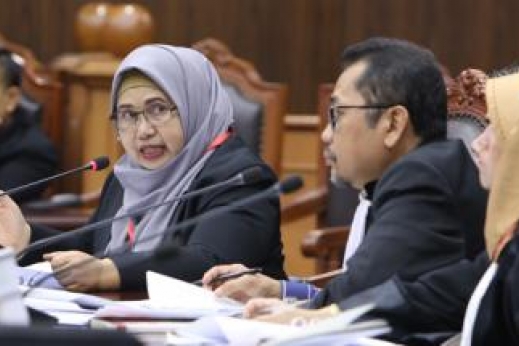
Medical Faculty lecturer of UGM Rr. Titi Savitri Prihatiningsih as expert for the Relevant Party delivering her expertise in the judicial review hearing of the Medical Practice Law, Wednesday (20/2) in the Plenary Courtroom of the Constitutional Court. Photo by Humas MK/ Puteri Budiman.
JAKARTA, Public Relations of the Constitutional Court—The Constitutional Court once again held the judicial review hearing of Article 1 number 12 of Law Number 29 of 2004 on Medical Practice on Wednesday (20/2/2019) in the Plenary Courtroom of the Constitutional Court. In the ninth session, the Indonesian Doctors Association (IDI) as Relevant Party presentedMedical Faculty lecturer of UGM Rr. Titi Savitri Prihatiningsih as expert.
On the petition No. 80/PUU-XVI/2018, Titi elaborated global structures and types of medical education in accordance with the development of medical education in many countries, including in Indonesia. The structure consists of basic, postgraduate, and continuing education. According to her, many countries apply one of the six models of education, one of which is high school followed by medical school. Before 2011, Titi added, after graduating from medical school, a doctor could practice independently. However, Regulation of the Ministry of Health No. 299/MENKES/PER/II/2010 ordered a one-year internship program to produce doctors who would be more competent in their fields.
"The a quo law means Indonesia has embraced the concept of Professional Public Partnership, so the Indonesian Medical Council (KKI) is a joint platform of all stakeholders to discuss medical education and practice, including the membership of KKI, as intended in Article 14 of the Medical Practice Law," Titi explained.
In accordance with the concept of professional regulation, Titi added, professional organizations have various functions, ranging from education to medical practice. With the expansion of these functions, autonomous bodies that surround them have also been formed. One function of a professional organization is to provide certification through the procurement of licensing exams so that member doctors meet the competency requirements. That is because in Indonesian medicine there are also the educational stage and the professional stage.
Titi explained that the education stage is the autonomy of the higher education, which in its implementation refers to the Indonesian Doctor Competency Standards (SKDI) approved by the Indonesian Medical Council. As for the profession stage, a doctor must also have practice competency, whose standards are adapted to practical needs. Through one year supervised internship, after a medical graduate is declared eligible, they will receive a doctor\'s competence certificate. "This is important to ensure that the doctors working in society have guaranteed knowledge and moral. So, the professionalism of doctors is intensively evaluation as such," explained Titi.
The case registered as No. 80/PUU-XVI/2018 was requested by 36 individual citizens consisting of lecturers, retired lecturers, and professors in the field of medicine. The Petitioners claimed that Article 1 numbers 12 and 13 as well as the Elucidation to Article 1, Article 29 paragraph (3) letter d, and Article 28 paragraph (1) of the Medical Practice Law could potentially harm the constitutional rights of the Petitioners. The Petitioners had previously said that Article 1 number 12 of the law on the definition of the phrase "Indonesian Doctors Association" was interpreted narrowly solely as the Executive Board of the Indonesian Doctors Association (PB-IDI) at the national level.
According to the Petitioners, within IDI there are several autonomous organizations, such as the Medical Ethics Honorary Council (MKEK), the Professional Services Development Council (MPPK), and the Indonesian Academy of Medicine (MKKI). They considered the definition of IDI in the a quo article had placed those organizations as subordinates of the PB-IDI, especially the MKKI, resulting in PB-IDI\'s authority intervening the academic/medical field.
If the a quo articles are not corrected, PB-IDI will seize control of the medical field from upstream to downstream due to the lack of checks and balances mechanism among institutions within IDI, as practiced by IDI seniors in the 2000s. Therefore, the Petitioners requested that the Constitutional Court justices declare the articles being reviewed conditionally constitutional. (Sri Pujianti/LA/Yuniar Widiastuti)
Wednesday, February 20, 2019 | 18:45 WIB 334