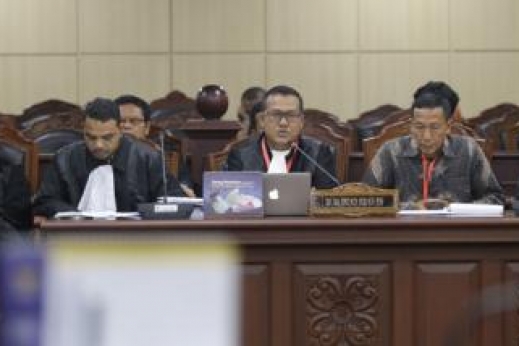
Legal counsel Dian Farizka reading the subjects of the petition in the preliminary judicial review hearing of Law No. 12 of 1995 on Correctional Institution and Law No. 31 of 2014 on the Amendment to Law No. 13 of 2006 on the Protection of Witness and Victim (PSK Law) on Monday (19/11) in the Courtroom of the Constitutional Court. Photo by Humas MK/Ifa.
The Constitutional Court held the preliminary judicial review hearing of Law No. 12 of 1995 on Correctional Institution and Law No. 31 of 2014 on the Amendment to Law No. 13 of 2006 on the Protection of Witness and Victim (PSK Law) on Monday (19/11) in the Panel Courtroom of the Constitutional Court. The hearing of case No. 90/PUU-XVI/2018 was presided over by Constitutional Justice Manahan M. P. Sitompul, accompanied by Constitutional Justices Suhartoyo and Enny Nurbaningsih.
Lecturer Tafsir Nurchamid, who is serving a sentence at the Sukamiskin Penitentiary, Bandung, explained that Article 14 paragraph (1) letters i and k of the Correctional Institution Law that reads, “Convicts have the right to: … (i) receive reduction of sentence (remission), … (k) receive parole,” and Article 1 number 2 of the PSK Law that reads, “The witness is a suspect, defendant, or convict who cooperates with the law enforcement to provide information on a criminal offense in the same case,” and Article 10A paragraph (3) letter b of the PSK Law that reads, “The reward for witness testimony as referred to in paragraph (1) may be in the form of: b. Parole, additional remission, and other rights of the inmate in compliance with the provision of regulations for convicted witness,” had violated the Petitioner’s constitutional rights.
In the Petitioner\'s petition, attorney Wahyu Nugroho explained that the granting of remission was on the basis of humanity, the purpose of which was to reduce the sentence. In addition, remission is also given to inmates who do services to the state or for humanity, or carry out actions that help the correctional institution. Thus, the ultimate goal of the correctional institution is to rehabilitate the prisoners. Since 1950, remission is no longer a gift, but has a right of every prisoner. The provisions of Article 1 point 2 of the PSK Law states that the phrase "criminal offense" does not recognize category of criminal offenses, both general and specific crimes. Whereas, in law enforcement practices, the phrase "criminal offense" in the a quo law based on that definition in the context of suspect witnesses has the potential for discrimination and legal uncertainty, resulting to injustice for convicts. The provisions of the a quo article, if not interpreted as "suspect witnesses are suspects, defendants, or convicts who cooperates with the law enforcement to provide information on a criminal offense in the same case," will contradict Article 28D paragraph (1), Article 28H paragraph (2), and Article 28I paragraph (2) of the 1945 Constitution.
In addition, according to Wahyu, the provisions of Article 10A paragraph (3) letter b along the phrase "additional remission" is part of the reward for testimony of the suspect witness, and there are no provisions on the classification of public or specific convicts, so there is room for convicts if after giving their testimony there is potential discrimination against other convicts.
"As a result, the Petitioner did not receive remission due to the enactment of Article 1 number 2 of the PSK Law if the suspect witness was not interpreted as a suspect, defendant, or convict who cooperated with the law enforcement to provide information on a criminal offense in the same case," said Wahyu.
Wahyu also said that institutionally, law enforcement institutions, including the criminal law sector, continued to develop. One of which was the birth of third institutions such as the KPK, which were ad hoc. In practice, the convicts handled by this institution received discriminatory treatment. One of them is not given remission even though the convict was a suspect witness and based on the PSK Law, he should have received a reward in the form of an additional remission. Meanwhile, corruption convicts who were handled by the police and the prosecutor\'s office get remission, regardless of whether they provide a testimony.
"As a result, the convicts do not get a legal guarantee to receive the reward and [this] causes legal uncertainty and does not provide justice for convicts," explained Wahyu.
Therefore, through the petitum, another attorney Dian Fariza argued that Article 14 paragraph (1) letters i and k of the Correctional Institution Law contradicts Article 28I paragraphs (1) and (4) of the 1945 Constitution conditionally as long as it is not interpreted as receiving sentence reduction or remission and receiving parole, and argued that the provisions of Article 1 point 2, Article 10 paragraph (3) letter b of the PSK Law are contradictory to Article 28D paragraph (1), Article 28H paragraph (2), and Article 28I paragraph (2) of the 1945 Constitution.
Status
Justice Manahan observed that it was necessary for the Petitioner to elaborate on his legal standing as a convict. He further requested elaboration of the relationship between the convict in question, who questioned suspect witnesses, defendants, and convicts who collaborated with the law enforcement. Justice Suhartoyo observed the Petitioner\'s concerned as if the convicts from the KPK were favored, while Justice Suhartoyo observed that the a quo norm did not discriminate among convicts.
"Therefore, the Petitioner is expected to be able to provide an affirmation of the argument on the relevance between other conditions that must be distinguished, from legal institution or law enforcement, is there really any relevance?" Justice Suhartoyo asked.
Justice Enny explained that the Petitioner requested that the Court interpret the a quo norm. She then asked the Petitioners to study previous Court decisions related to the a quo case. "So that the Petitioner shows [which part is different from the previous case]. The Court [has no capacity for] hearing concrete cases," she explained. (Sri Pujianti/LA/Yuniar Widiastuti)
Wednesday, November 21, 2018 | 15:55 WIB 309