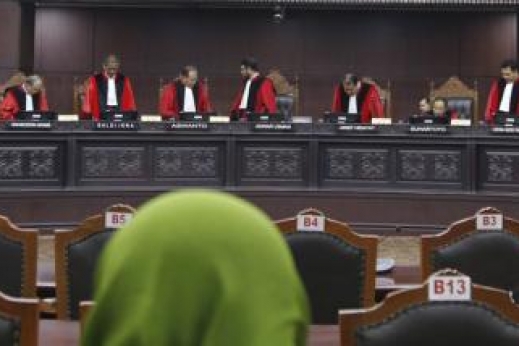
Plenary ruling hearing of the judicial review of the Election Law, Thursday (25/10) in the Plenary Courtroom of the Constitutional Court. Photo by Humas/Ganie.
As candidate pairs must be submitted prior to the elections, pursuant to the 1945 Constitution, it is impossible for first-time voters to have been involved in the nomination of a particular candidate pair. Not to mention, the Petitioner wished first-time voters to have been supporting a certain political party nominating the candidate pair. This contradicts the Petitioner’s own argued status as a first-time voter in the upcoming presidential and vice presidential election, especially if his voting right is only obtained close to the Election Day.
This was the opinion of the Court conveyed by Deputy Chief Justice of the Constitutional Court Aswanto in the ruling hearing of the judicial review of case No. 58/PUU-XVI/2018, Thursday (25/10). Based on the legal consideration, although at a glance the Petitioner’s argument signified constitutional loss due to the enactment of Article 222 of the Election Law, the Court believed that the provision of the article was not a violation of the 1945 Constitution and was not proven to have caused constitutional loss for the Petitioner.
“The opinion of the Court is based on the argument that in the 2019 Elections, it cannot be guaranteed that the Petitioner will vote the same political party in the election of the House members and that which nominates a presidential and vice presidential candidate,” he said.
The Court was of the opinion that, in relation to the Petitioner’s legal standing because Article 6A paragraph (2) of the 1945 Constitution stipulates that presidential and vice presidential candidates can only be nominated by a political party or a coalition before the election, the constitutional right to nominate presidential and vice presidential candidates is possessed by the political party or coalition participating in the election and indirectly by the voters who have used their right to vote in the previous 2014 Election, and that the votes received by the political party in the 2014 Election are used as reference in calculating the presidential threshold of the 2019 Presidential and Vice Presidential Election.
In the a quo case, according to the Court, because the Petitioner is not acting as a political party and is not a voter who have voted in the 2014 Election, but rather a first-time voter who did not vote in the 2014 Election as he stated, he did not have the legal standing to file the a quo petition.
Based on all the legal considerations, the Court was of the opinion that the Petitioner did not have the legal standing to file the a quo petition. Even if he had, quod non, his argument was legally groundless. Therefore, the petition by Muhammad Dandy could not be accepted.
No Status as Legal Entity
The panel of justices also decided that the petition No. 61/PUU-XVI/2018, filed by Chairperson of the Independent People’s Government Committee Party Sri Sudarjo, cannot be accepted. The Court was of the opinion that the essence of the registration of political party legal entity to the ministry (state institution) was to affirm publicity since the organizational management structure must be national.
Reading the Court’s opinion, Constitutional Justice Suhartoyo stressed that valid recognition by the state would lead to legal certainty and protection under the Constitution in a constitutional democratic rule, and would make the political party a formal organization that would channel political aspiration of the people in the nation’s development. Especially, a formal organization whose existence is recognized by a multi-party state has a strategic role and position, placing its smart main political actors in articulating and aggregating interests.
The Court was of the opinion, as detailed in the considerations, that given that one of the requirements of a political party is registration in the ministry to obtain a legal entity status and that the Petitioner could not produce such a document in the a quo petition, the argument of the Petition that they were a political party that had suffered constitutional loss due to the enactment of the impugned articles was legally groundless. Not to mention, Article 6A paragraph (2) of the 1945 Constitution stipulates that in order to nominate a presidential and vice presidential candidate, a political party or a coalition must be eligible for elections.
Therefore, the Court declared the Petitioner to not have a legal standing as petitioner in the a quo petition. The verdict adjudicated, declared the Petitioner’s petition could not be accepted. (Nano Tresna Arfana/LA/Yuniar Widiastuti)
Thursday, October 25, 2018 | 17:29 WIB 238