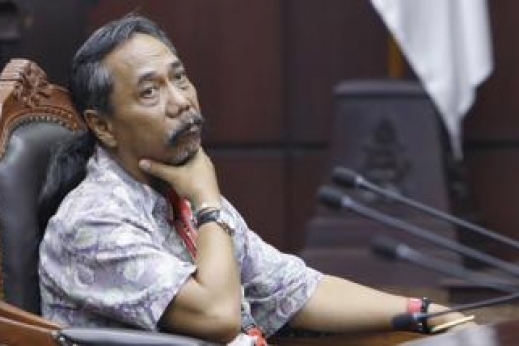
Martinus Nuroso as Principal Petitioner present in the ruling hearing of the judicial review of the Manpower Law Thursday (25/10) in the Courtroom of the Constitutional Court. Photo by Humas MK/Ganie.
The Constitutional Court (MK) rejected the petition filed by the Forum for BNI Pensioners entirely in the judicial review of Law No. 13/2003 on Manpower. The decision No. 68/PUU-XVI/2018 was read on Thursday (25/10) in the Plenary Courtroom of the Constitutional Court.
Reading the Court\'s considerations in the opinion of the Court, Constitutional Justice Wahiduddin Adams said that in the beginning the Petitioner argued that the provision of Article 167 paragraph (3) did not align with the Elucidation to Article 167 paragraph (3) of the Manpower Law. However, in the petitum, the Petitioner requested that the Court apply retroactive decision if the a quo petition was granted. In addition, in the subject matter of the petition, the Petitioner also appealed to the Court to declare Article 167 paragraph (3) of the Manpower Law not in accordance with the 1945 Constitution and need amendment. "Thus, the Court considers it is unclear what exactly the Petitioner is asking for," he explained before the hearing chaired by Chief Justice Anwar Usman along with the other constitutional justices.
If what was requested is related to the constitutionality of the a quo article, the Court had declared its stance in Decision Number 46/PUU-XVI/2018, so it is irrelevant to question the constitutionality of the article. Meanwhile, Justice Wahiduddin added, if what was petitioned by the Petitioner is the imposition of a retroactive decision by the Constitutional Court if the application was granted, it would be unusual.
"In addition, if the petition for the enforcement of retroactive decision was granted, it it would be contrary to Article 47 of the Constitutional Court Law. Based on these considerations, the Petitioner\'s petition is unreasonable according to law," Justice Wahiduddin said.
The Petitioner had previously claimed that Article 167 paragraph (3) of the Manpower Law is contrary to the norms of the body that reads, "… calculated with the severance pay shall be the pension whose contributions/premiums have been paid by the entrepreneur." According to him, the loss suffered by the Petitioner began in 2013, when the severance pay for workers entering retirement was underpaid. The Petitioner had held meetings with various parties to fight for their rights, including filing a lawsuit with the Industrial Relations Court.
However, the Industrial Relations Court Decree No. 68/PHI.G/2014/PN.JK.PST dated September 11, 2014 rejected the Petitioner\'s claim on the grounds that severance pay had been regulated in a quo article. The judges at the hearing assessed that the existing formulation and calculation results had been in accordance with the existing laws and regulations. In conclusion, there was no evidence that irregularities have resulted in underpayments so there is no obligation for the Defendant to pay the severance pay as demanded by the Plaintiffs. (Sri Pujianti/LA/Yuniar Widiastuti)
Thursday, October 25, 2018 | 17:50 WIB 228