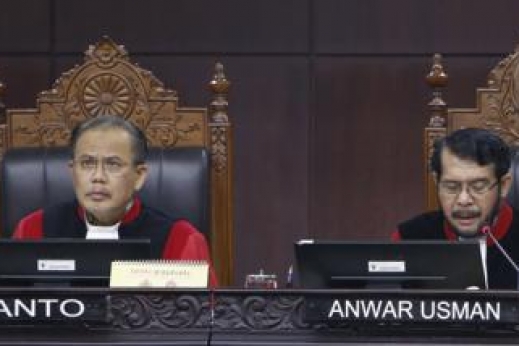
Plenary ruling hearing of the Law on Electronic Information and Transactions (ITE), Thursday (25/10) in the Plenary Courtroom of the Constitutional Court. Photo by Humas MK/Ganie.
The Constitutional Court decided not to accept the judicial review of Law No. 19/2016 on the Amendment to Law No. 11/2008 on Electronic Information and Transactions (ITE Law) and Law No. 22/2009 on Road Traffic and Transportation (LLAJ Law), Thursday (25/10). The Court deemed the petition obscure (obscuur libel). Declares the Petitioners’ petition not accepted,” said Chief Justice Anwar Usman in the presence of the other constitutional justices.
In the opinion of the Court, Constitutional Justice Suhartoyo stated that the petition of the Petitioners regarding the unconstitutionality of Article 1 point 6a of the ITE Law is mutatis mutandis where legal considerations to the Constitutional Court Decision Number 27/PUU-VII/2009 apply.
The Petitioners, he added, also argued that Article 157 of the LLAJ Law was contrary to Article 5 paragraphs (1) and (2); Article 20 paragraphs (1) and (2); Article 21 paragraphs (1) and (2); Article 22 paragraphs (1), (2), and (3) of the 1945 Constitution. The Petitioners had argued that a government regulation, in a higher position than the ministry regulation, if not approved by the House of Representatives, must be revoked.
"With regard to the aforementioned argument, if what is meant by the Petitioners is that government regulations must get the approval of the House of Representatives, then the House\'s legal system is not known in the formulation of government regulations," he said on Case Number 64/PUU-XVI/2018.
Conventional motorcycle taxi drivers from Batam filed a judicial review of Article 157 of the LLAJ Law and Article 40 paragraphs (1), (2a), and (2b) of the ITE Law. Rahmani and Marganti as the Petitioners who explained that according to the a quo provision, two-wheeled motorized vehicles are not included in the category of public transport both in trajectories and not in trajectories. Meanwhile, according to the Petitioners, long before the provision, motorcycle taxis already existed and bicycle ojek in some areas still exists today. Thus, the Petitioners feel that their profession is seen as illegal by the Government or the authorities.
The Petitioners further explained in their petition that this provision had eliminated or ignored the constitutional basis in delegating authority to regulate. According to the Petitioners, the provision states explicitly that the Minister has the authority to regulate, while in the Constitution the Minister is not. In addition, the Petitioners further elaborated that the provision of Article 40 paragraphs (1), (2a), and (2b) of the ITE Law have given a different opinion on the application or use of the Law where the LLAJ Law is at the same level as the ITE Law. The a quo article was the basis for the development of the Minister Regulation No. 108/2017 that replaced Minister Regulation No. 26/2016, which replaced Minister Regulation No. 32/2016.
Materially, Marganti added, this greatly affects those who work as conventional motorcycle drivers who wait at a base around housing neighborhoods. Due to online transportation, they hardly get any passengers every day because their fees are more expensive than that of online motorcycle taxis. In the petitum, the Petitioners requested that the Constitutional Court declare the a quo law contrary to the 1945 Constitution and not having binding legal force. (Arif Satriantoro/LA/Yuniar Widiastuti)
Thursday, October 25, 2018 | 18:24 WIB 181