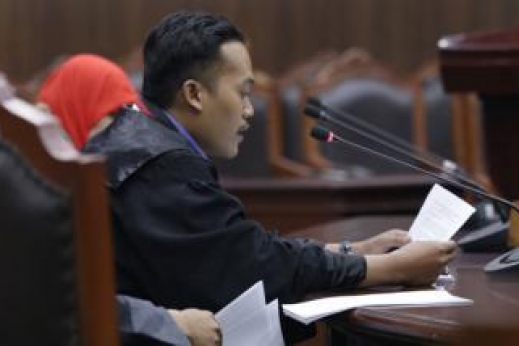
The Petitioners’ attorney Eep Ependi delivering the petition revision in the preliminary material review of Law No. 17 of 2017 on General Elections, Tuesday (23/10) in the Courtroom of the Constitutional Court. Photo by Humas MK/Ifa.
The revision hearing of case No. 81/PUU-XVI/2018 regarding the judicial review of Law No. 17 of 2017 on General Elections took place on Tuesday afternoon (23/10). Attorney Eep Ependi delivered the revision points of the petition.
“Your Honors, the Petitioners would first like to convey that the touchstone used is different from that in the initial petition. Formerly Article 28H paragraph (1) to 28D paragraph (1) of the 1945 Constitution. Article 28J paragraph (2) remains,” said Eep to the constitutional justices led by Constitutional Justice I Dewa Gede Palguna.
The Petitioners added a change to the authorities of the Constitutional Justices on page 3 number 4, that is Law No. 12 of 2011, not Law No. 24 of 2011. On legal standing, the article being challenged is now on Number 1, page 4. The Petitioners also changed the elaboration of the legal standing
The Petitioners believe that to reflect people\'s sovereignty, the election of members of the DPR, DPD, and DPRD as legal instruments must be based on rationality, so in the process, the people must be given options of candidates whose actions are beyond reproach.
They also stressed that Article 182 letter g and Article 240 paragraph (1) letter g of the Election Law must be declared contrary to fair legal certainty in Article 28D paragraph (1) of the 1945 Constitution. The enactment of the article has given equal treatment to former convicts regardless of the kind of crime the committed. This implies applying a provision of the law on two different situations.
Petitioners Muhammad Hafidz, Abda Khair Mufti, and Sutiah are represented by attorney Eep Ependi. They challenge the constitutionality of the phrase "ex-convict" in Article 182 letter g and Article 240 paragraph (1) letter g of the Election Law, which if not declared contrary to Article 28I paragraph (2) of the 1945 Constitution and not legally binding may show discrimination. The a quo norm treats all ex-convicts equally by providing opportunities to run for public office or political office, without considering the impact experienced by individuals, community groups, or the state at large for a number of years as consequences of the actions committed.
The Petitioners were worried that the increasing arrests of public officials for corruption of state finances originating from public taxes would have an impact on the community itself, including the Petitioners. Slower economic growth and investment as well as weak purchasing power. As a result of the increasingly high prices of basic necessities, not to mention the possibility that this will result in reduced subsidy assistance from the state that Petitioner III has been receiving in the form of rice and food.
The threat to the Petitioners’ rights to physical and spiritual prosperity provided by the state due to the widespread impact of corruption, said Eep, is not because of only weak law enforcement but also the absence of restrictions in legal norms that should be regulated by law to guarantee recognition and respect for the rights and freedoms of others in meeting fair demands in accordance with moral considerations, religious values, security, and public order in a democratic society. (Nano Tresna Arfana/LA)
Translated by: Yuniar Widiastuti
Tuesday, October 23, 2018 | 16:45 WIB 171