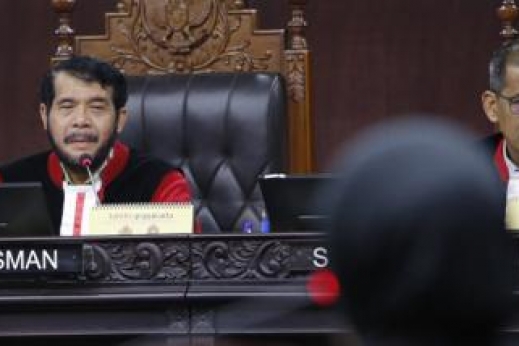
Plenary hearing to listen to the statement of the Director of Legislation Litigation of the Law and Human Rights Ministry Ninik Hariwanti in the judicial review petition on the General Elections Law, Monday (22/10) in the Plenary Courtroom of the Constitutional Court. Photo by Humas MK/Gani.
The Government denied the lack of limitation on campaign funds in Law No. 7/2017 on General Elections (Election Law) argued by Muhammad Hafidz and partners who petitioned for case No. 71/PUU-XVI/2018. The Government believed that Article 326 of the Election Law in fact describes the steps that must be taken by the presidential and vice presidential candidates in managing campaign funds so that money politics does not occur, such as obligatory audit, funding transparency, and public announcement.
This was conveyed by the Director of Legislation Litigation of the Law and Human Rights Ministry Ninik Hariwanti on behalf of the Government in the judicial review petition on the Election Law on Monday (22/10/2018) in the Plenary Courtroom of the Constitutional Court. "The element of prudence in receiving campaign funds is regulated in many articles. Thus the Petitioner\'s concerns are unfounded and wrong," Ninik explained.
Ninik added that despite the amount of campaign funding coming from presidential and vice-presidential candidates and political parties are not limited, she explained that this remained the responsibility of the candidates in question. Furthermore, the funds obtained must be placed in a special account and clearly written in the bookkeeping of campaign funds.
"So, all contracts and expenditures before the campaign period are regulated and its management is also regulated until the campaign period. And contributions from other parties, including contracts and expenditures incurred by the candidate pair must be reported in a clear audit," she added before the hearing chaired by Chief Constitutional Justice Anwar Usman.
In addition, Ninik also added that election participants are also prohibited from accepting donations from unclear individuals, which according to reasonableness and propriety cannot possibly provide campaign funding assistance. Therefore, the Petitioners\' concern of campaign funding is not reasonable according to the Government. It is merely an unfounded and false assumption. Even the campaign team is prohibited from receiving campaign funds from unclear sources. "If anything that is assumed by the Petitioners happens, that is, the [donor] identities not being recorded, then there will be criminal provisions regulating the fraud," explained Ninik.
Petitioners Dorel Almir, Abda Khair Mufti, and Muhammad Hafidz claimed that the provision of campaign funds as stipulated in Article 326 of the Election Law has the potential to impair their constitutional rights. The provision is detrimental because it does not regulate the limitation of campaign funding for the presidential and vice presidential election originating from one or a pair of candidates for the president and vice president or from political parties. As election participants, presidential and vice presidential candidate pairs or political parties are given the right to receive campaign funds that are not binding on individuals and may not exceed 2.5 billion rupiah or are from non-governmental groups, companies, and/or business entities that cannot exceed 25 billion rupiah. However, the Election Law does not regulate the limits of the granting of campaign funds for the election of the president and vice president concerned or for political parties.
Therefore, the Petitioners requested that the Constitutional Justices declare Article 326 of the Election Law to not have binding legal force insofar as the campaign funds for the election of president and vice president originating from individuals including president and vice president candidates must not exceed Rp85,000,000,000.00 (eighty five billion rupiahs), as well as those from groups including political parties and/or joint political parties may not exceed Rp850,000,000,000.00 (eight hundred fifty billion rupiahs), companies and/or non-government business entities. If the a quo article is declared conditionally constitutional, Darel added, as citizens who are also obliged to safeguard the implementation of fair elections, the Petitioners hoped that the elected government of the president and vice president will not be concerned by the interests of donors who can harm the public interest.
Before concluding the session, Chief Justice Anwar said that the hearing would commence on Wednesday, November 14, 2014 at 11:00 WIB. The Petitioners or Relevant Party are expected to provide written statements at least two days before the next hearing. (Sri Pujianti/LA)
Translated by: Yuniar Widiastuti
Tuesday, October 23, 2018 | 15:56 WIB 165