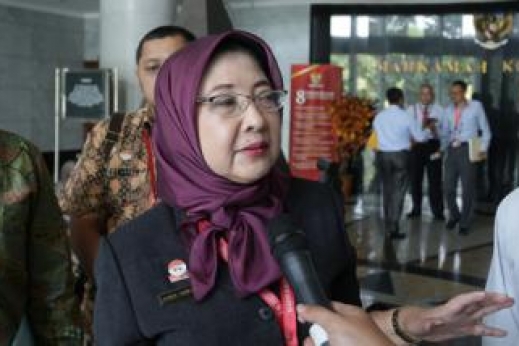
Director of Legislation Litigation of the Law and Human Rights Ministry Ninik Hariwanti representing the Government after judicial review hearing of Law Number 40 of 2007 on Limited Liability Company, Wednesday (11/10) in the Courtroom of the Constitutional Court. Photo by Humas MK/Ifa.
The Board of Directors is the organ of the company responsible for managing the company, both in and out of court according to the Articles of Association of the organization. Pursuant to Article 146 paragraph (1) letter c point a of the Limited Liability Company (PT) Law, the dissolution of the company is filed first by the board of directors, while the court in accordance with its authority only accepts the reason for the dissolution of the company. Thus, the Government was of the opinion that there is no constitutional loss due to the enactment of the a quo norm. This was conveyed by the Director of Legislation Litigation of the Law and Human Rights Ministry Ninik Hariwanti in a follow-up hearing of Law No. 40/2007 on Limited Liability Company (PT) in the Plenary Courtroom of the Constitutional Court, Wednesday (11/10).
In the session led by Deputy Chief Justice of the Constitutional Court, Aswanto, Ninik asserted that the arguments petitioned by PT Baraventura Pratama and the two individual citizens were a matter of norm implementation. "This is due to a lack of understanding of the norms and their validity so it is not appropriate to conduct a judicial review," Ninik explained.
With regard to the arguments of the Petitioners that the elucidation to the a quo article does not reflect legal certainty, the Government was of the opinion that the Petitioners could not show potential constitutional losses, so that the Government considered that there was no causal relationship due to the enforcement of the norm because the norm has placed the rights of the board of directors, board of commissioners, and shareholders in equal positions in the dissolution of the company. "That the dissolution of the company must still be based on the company\'s reasons because the board of directors are the ones who have the legal authority," Ninik explained regarding case No. 63/PUU-XVI/2018.
The Petitioner had previously conveyed that the a quo article had caused legal uncertainty for for limited companies that have not undertaken business for three years or more because it does not provide certainty on which party has the right to prove the deactivation by submitting a notification letter to the tax authority. Either that or whether this right is only given to one party or also given to all parties as mentioned in the a quo article, namely shareholders, directors, and board of commissioners.
According to the Petitioners, the a quo article also contradicts the substance and norm contained in the editorial article because it has the potential to only provide benefits or rights to one party to dissolve a PT. Therefore, the Petitioners requested that the Panel of Justices declare the a quo norm conditionally unconstitutional as long as it is not interpreted that the notification letter of a limited liability company that has not undertaken business activities or is inactive for 3 years or more that is submitted to the tax authority can be submitted by the board of directors, shareholders, or board of commissioners of the company.
Before concluding the session, Justice Aswanto reminded the Petitioners to submit a written statement from their three experts no later than two days before the next session to be held on Wednesday, October 24, 2018 at 11.00 a.m. (Sri Pujianti/LA/Yuniar Widiastuti)
Thursday, October 11, 2018 | 16:58 WIB 261