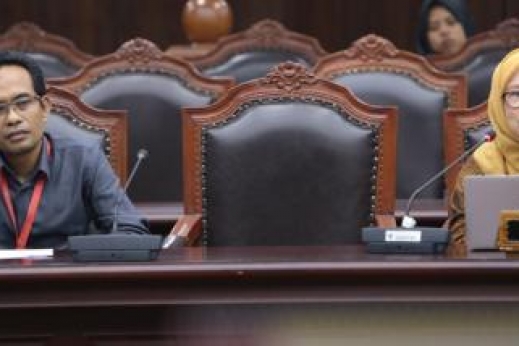
Experts M. Ali Syafa\'at and Efridani Lubis for the Petitioners delivering their expertise in the judicial review hearing of the Limited Liability Company Law (PT Law), Wednesday (10/10) in the Plenary Courtroom of the Constitutional Court. Photo by Humas MK/Ganie.
The appointment of directors as liquidators by the General Meeting of Shareholders (GMS) potentially creates a conflict of interest. This was conveyed by Faculty of Law lecturer of the University of Malang, M. Ali Syafa\'at, who was present as expert for the Petitioners in the judicial review hearing of Law Number 40 of 2007 on Limited Liability Companies (PT Law), on Wednesday (10/10).
Syafa\'at explained that the board of directors is the representative of the majority shareholders who decide through the GMS. On the other hand, he added, during liquidation, which must provide legal certainty and protection, of course not only the majority shareholders must be protected, but also creditors, workers, and minority shareholders.
If the liquidators are in the board of directors, there is sufficient potential for fraud due to a conflict of interest. Therefore, if liquidation is not carried out by people who have the qualification and instead by those who have a conflict of interest, decision, and certainty, and legal protection that are expected to be achieved through liquidation, which is the main objective of the PT Law, will never be achieved,” he said before the panel of justices led by Deputy Chief Justice Aswanto.
Clear Regulations
Syafa\'at added that all legal products are essentially providing legal protection and certainty. The PT Law broadly describes the process of establishing up to dissolving a PT (limited liability company). During dissolution of a PT, the liquidator is essential. “If there are no clear regulations on the qualification of liquidators, this clearly does not provide legal certainty and protection,” he asserted.
Syafa\'at believed this condition provided indirect losses to the liquidator, because the public saw the liquidator as not requiring qualification. This results in the community looking down on the liquidator profession, even though many liquidators have qualification.
Presumptive
In the hearing, the House represented by Arsul Sani said that the Petitioners did not suffer any loss due to the enactment of Article 142 paragraph (2) letter a and Article 142 paragraph (3) of the PT Law. The House believed that the Petitioners\' argument was presumptive and did not clarify concretely the loss of constitutional rights and/or authorities as liquidators. The Petitioners\' assumption that the absence of regulation regarding the liquidator profession in the PT Law caused legal uncertainty was said to be unwarranted.
“The Petitioners did not prove concretely the losses caused by the enactment of the PT Law, instead comparing the provision on the liquidator in the PT Law with that of the curator in the Law on Bankruptcy and Suspension of Debt Payment Obligations,” Asrul asserted in response to the petition.
A number of liquidators registered as Petitioners of case No. 29/PUU-XVI/2018 had questioned the absence of clear requirements related to the liquidator profession. This has led to legal uncertainty and criminalization threat of the Petitioners\' profession. The Petitioners said that the factual losses that they suffered are that many non-Indonesian citizens (foreign) liquidators conduct liquidation practices on Indonesian legal entities or foreign companies in Indonesia. On the other hand, the potential loss that liquidators can suffer is the absence of legal protection due to unclear definition of the liquidator. This is seen as a cause to the criminalization of the liquidator profession. (Arif/LA/Yuniar Widiastuti)
Thursday, October 11, 2018 | 15:36 WIB 232