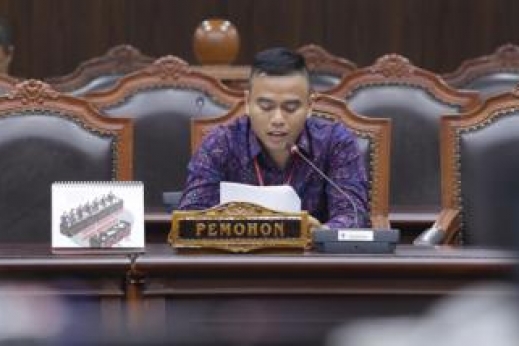
Abdul Hakim as Petitioner reading out his petition in the preliminary hearing of the judicial review of Law Number 13 of 2003 on Manpower, Thursday (13/9) in the Courtroom of the Constitutional Court. Photo by Humas MK/Ifa.
Law No. 13/2003 on Manpower was reviewed materially once again to the Constitutional Court on Thursday (13/9) in the Courtroom of the Constitutional Court. The case No. 72/PUU-XVI/2018 was petitioned by Abdul Hakim, an Indonesian citizen who works as an employee of PT Internusa Food.
Without legal counsel, Abdul conveyed that Article 59 paragraph (7) of the Manpower Law potentially impairs his constitutional rights. The a quo article reads, “Any work agreement for a specified period of time that does not fulfill the requirements referred to under paragraphs (1), (2), (4), (5), and (6) shall, by law, become a work agreement for an unspecified period of time (PKWTT).”
The Petitioner felt disadvantaged by the enactment of the a quo article because since he first worked on March 6, 2012, he was bound by PT Internusa Food with a work agreement for a specified period, which has been extended 11 times. He had attempted to change its status to one for an unspecified period of time through the Industrial Relations Court Decision of the Central Jakarta District Court No. 6/Pdt.Sus-PHI/2018/PN.Jkt.Pst dated July 12, 2018 (IRC Decision). The IRC Decision states that the employment status of the Petitioner, who was bound by a work agreement for a specified period (PKWT) by PT Internusa Food, had been declared to be turned into a work agreement for an unspecified period of time (PKWTT). However, the IRC Decision resulted in PT Internusa Food terminating the employment (PHK) of the Petitioner unilaterally since July 28, 2017 with the reason that the PKWT agreement had expired. However, Abdul added, the company must first pay compensation in the form of severance pay of approximately IDR 54 million and wages during the termination process amounting to approximately IDR 13 million. Regarding the decision, PT Internusa Food filed an appeal to the Supreme Court for the Central Jakarta IRC Decision be declared not legally binding and could not be implemented.
Abdul further explained that on the transition from the initial employment from PKWT to PKWTT, the Supreme Court had eliminated the worker’s rights in the form of wages during the termination process as established by the IRC. Accordingly, the Petitioner concluded that the wages during the termination process based on the IRC Decision could potentially be eliminated by the Supreme Court, which would result in the Petitioner’s loss of constitutional right to obtain compensation and fair, appropriate employment treatment namely wages during the termination process.
"The lack of guarantee of rights arising from the transition of a worker’s employment status from one for a specified period into PKWTT as regulated in the a quo article potentially impairs the constitutional right of the Petitioner to obtain compensation and fair, appropriate employment treatment," Abdul explained before the Panel of Justices led by Constitutional Justice Wahiduddin Adams.
Therefore, the Petitioner requested that the Constitutional Justices revoke Article 59 paragraph (7) of the Manpower Law. In addition, he requested that the a quo article be declared conditionally unconstitutional if it was interpreted to abolish the right of the worker to wages during the termination process which was originally based on a work agreement for a specified period into one for an unspecified period.
Argument of the Petition
Responding to the petition, Constitutional Justice Wahiduddin Adams advised the Petitioner to strengthen the argument of the petition by not only focusing on the decisions of the Constitutional Court that rejected but also those that accepted similar cases. This is necessary to strengthen the argument of the petition so that it does not go into an exact same case.
While Constitutional Justice Manahan M.P. Sitompul suggested that the Petitioner look at his legal standing. According to him, in relation to the legal standing, the Petitioner was expected to be able to emphasize the explanation of the constitutional impairment when he was employed with PKWTT. "This is necessary to see whether this is a norm issue or a case of unclear arrangements," Justice Manahan said.
Justice Enny Nurbaningsih observed that the Petitioner tend to focus more on the concrete case. For this reason, she requested that the Petitioner pay close attention to elaborating the argument of the petition and the different reference in the case petitioned. "Can the Petitioner elaborate the losses resulting from the enactment of the a quo article, so that it looks different from previous petitions that reviewed [the same] law?" she suggested.
Before concluding the hearing, Justice Wahiduddin reminded the Petitioner to revise the petition and submit it no later than Wednesday, September 26, 2018 at 10:00 a.m. to the Registrar’s Office of the Constitutional Court. (Sri Pujianti/LA/Yuniar Widiastuti)
Thursday, September 13, 2018 | 16:13 WIB 284