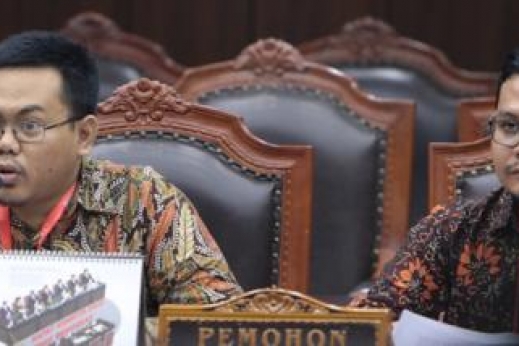
Faisal Alhaq Harahap and Muhammad Raditio Jati Utomo as Principal Petitioners presenting the principal points of the petition of the judicial review of the Terrorism Eradication Law, Thursday (13/9) in the Plenary Courtroom of the Constitutional Court. Photo by Humas MK/Ganie.
Islamic Students Association (HMI) activists filed a judicial review on the definition and motives of terrorism as stipulated in Article 1 number 2 of Law No. 5/2018 on the Terrorism Eradication Law. The preliminary hearing of Case No. 73/PUU-XVI/2018 on Thursday (13/9) took place in the Courtroom of the Constitutional Court.
Faisal Alhaq Harahap and Muhammad Raditio Jati Utomo as Petitioners felt that they had been harmed by the enactment of Article 1 number 2 of the Terrorism Law. The a quo article reads, "Terrorism is an act that uses violence or threats of violence that creates widespread terror or fear, which can cause mass casualties, and/or cause damage or destruction to strategic, vital objects, the environment, public facilities, or international facilities with motives of ideology, politics, or security disturbances."
In the session led by Constitutional Justice Arief Hidayat, Faisal said that the definition of terrorism in Article 1 paragraph (2), especially the phrase "with ideological, political, or security disturbances" could be a tool for those in power to incriminate. He added that the phrase could be used to suppress and prosecute any action that is not terrorism.
"If a government regime does not like an ideology and certain political views that actually do not conflict with Pancasila and the 1945 Constitution and the movement carried out [is not] terrorism, for practical political reasons and mere power the government regime could use the phrases in the a quo article as a tool to persecute certain groups, including Muslims," he explained.
Meanwhile, Raditio also said that the a quo article could create a stigma that Islam preaches terrorism. In addition, he added, Islam can easily be incriminated if one day the regime in power does not like the views of Islam. He also considered the a quo article limiting efforts to eradicate terrorism because motives to commit acts of terrorism are not limited only to the definition in the a quo law, but also various other motives.
"One of the motives of terrorism not mentioned in the a quo law is the economic motive, that is, the bombing at Alam Sutera Mall by Leopard Vishnu Kumala in order to [receive bitcoins] by doing the actions," he said.
Therefore, in the petitum, the Petitioners requested that the Constitutional Court declare the phrase "with motives of ideology, politics, or security disturbances" in Article 1 point 2 of the Terrorism Law contrary to the 1945 Constitution and not have binding legal force.
Legal Standing
In response to the petition, Constitutional Justice Arief Hidayat suggested that the Petitioners elaborate on the harmed constitutional rights. He observed that there had been no explanation of actual and potential losses. "The legal standing is still general and not specific," he said.
Meanwhile, Constitutional Judge I Dewa Gede Palguna stated that the annulment of the phrase would result in a repressive state because, he added, the phrase limits actions classified as terrorism. "If it was not restricted, then the government could directly declare any action as an act of terrorism," he explained.
Constitutional Court Justice Manahan M.P. Sitompul mentioned the legal standing is because the Petitioners used their status as activists of the Islamic Students Association (HMI). "It needs to be clarified whether the Petitioners represent the organization because they are neither its chairman nor secretary general of the organization. [An organization] is usually represented by the chairman and secretary general of the organization," he explained.
In addition, Justice Manahan requested that the Petitioners study petition No. 55/PUU-XVI/2018 that questioned the same norm. According to him, if the articles and arguments are similar, the Petitioners can combine or withdraw their petition. However, he added, if they would like to continue, the Court will not be in the way. (Arif/LA/Yuniar Widiastuti)
Thursday, September 13, 2018 | 17:43 WIB 330