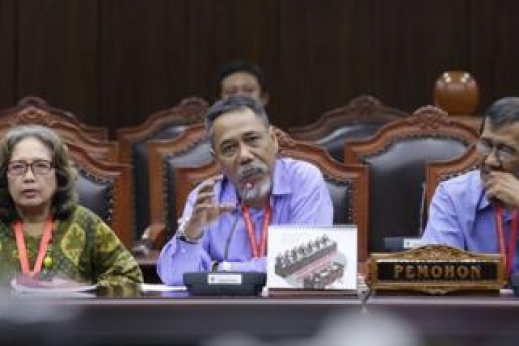
Principal Petitioner Martinus Nuroso explaining the main points of the petition in the preliminary hearing of the judicial review of the Manpower Law, Wednesday (5/9) in the Courtroom of the Constitutional Court. Photo by Humas MK/Ifa.
Chairperson of t he Forum for Pensioners of Bank Negara Indonesia Martinus Nuroso reviewed the provision on severance payment stipulated in Law No. 13/2003 on Manpower to the Constitutional Court on Wednesday (5/9). The preliminary hearing held in the Plenary Courtroom of the Constitutional Court was chaired by Constitutional Justice Wahiduddin Adams accompanied by Constitutional Justices Saldi Isra and Enny Nurbaningsih.
Regarding the petition No. 68/PUU-XVI/2018, the Petitioner, accompanied by several of his organization members, claimed that Article 167 paragraph (3) of the Manpower Act which reads, "If the entrepreneur has included the worker/laborer in a pension program whose contributions/premiums are paid by the entrepreneur and the worker/laborer (sharing), then that which is calculated with the severance pay shall be the pension whose contributions/premiums have been paid by the entrepreneur," is contrary to the norms of the body that reads, "calculated with the severance pay shall be the pension whose contributions/premiums have been paid by the entrepreneur."
The loss suffered by the Petitioner began in 2013, when the severance pay for workers entering retirement was underpaid. The Petitioner had held meetings with various parties to fight for their rights, including filing a lawsuit with the Industrial Relations Court. However, the Industrial Relations Court Decree No. 68/PHI.G/2014/PN.JK.PST dated September 11, 2014 rejected the Petitioner\'s claim on the grounds that severance pay had been regulated in a quo article. The judges at the hearing assessed that the existing formulation and calculation results had been in accordance with the existing laws and regulations. In conclusion, there was no evidence that irregularities have resulted in underpayments so there is no obligation for the Defendant to pay the severance pay as demanded by the Plaintiffs.
"So, between the body and the article are not synchronized. And this was interpreted unilaterally by the bank. We retired in 2010 and were paid only in 2012. The calculation was cut so the nominal paid was reduced. As a result, the pension fee was burdened on workers," Martinus explained.
Therefore, the Petitioner requested that the Constitutional Justices declare that the Manpower Law, especially Article 167 paragraph (3) and its elucidation, would lead to uncertainty contrary to the 1945 Constitution of the Republic of Indonesia and not have binding legal force.
Legal Standing
Responding to the petition, Constitutional Justice Saldi Isra requested that the Petitioner improve his legal standing. He questioned the legal standing of the Petitioner as a party on behalf of the community or as an individual. "Therefore, if [you are acting] on behalf of the community, please refer to the community statute/bylaws," he suggested.
In addition, Justice Saldi also suggested that the Petitioner construct a part of the a quo article that is detrimental to him and review Constitutional Court Decision N. 46/PUU-XVI/2018 on a similar case. Considering what is argued is the practice of implementing the norm, "[Get around] the implementation, explain the constitutionality so as not to get stuck in the same issue as the previous Petitioner," he explained.
As a Whole
Meanwhile, Constitutional Justice Enny Nurbaningsih requested that the Petitioner carefully study the a quo law that cannot be comprehended in bits and pieces. It is necessary for the Petitioner to discuss with the organization under him the a quo norm as a whole. In addition, the Petitioner also needs to understand the nature of the example described in the a quo article. "So, please explain whether there are constitutional rights resulting from the formulation of this norm," she said.
Meanwhile, Constitutional Justice Wahiduddin Adams said that the Petitioner should revise the petition by studying the various formats for submitting judicial review on the Constitutional Court\'s website. This is necessary, considering the case filed by the Petitioner is similar to a petition that had been decided by the Constitutional Court some time ago. "At least it will enrich your petition so that the reference can be different from a previous one," he explained.
At the end of the hearing, Justice Wahiduddin reminded the Petitioner to revise the petition and submit it on September 18, 2018 at 10.00 a.m. at the latest to the Registrar\'s Office of the Constitutional Court. (Sri Pujianti/LA/Yuniar Widiastuti)
Wednesday, September 05, 2018 | 17:22 WIB 284