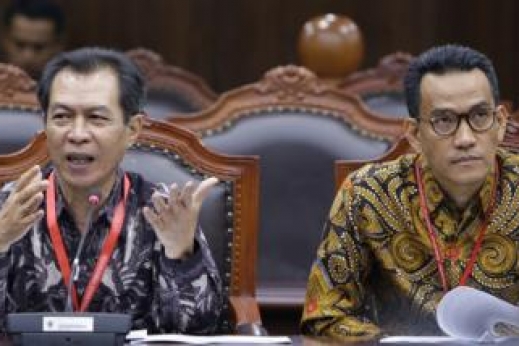
The experts presented by the Government of Revrisond Baswir and Refly Harun provide expertise in the trial of judicial review of the Law on State-Owned Enterprises (UU BUMN), Tuesday (26/6) in the Plenary Courtroom of Constitutional Court. Photo by Humas MK/Ganie.
There must be a strict separation between the assets of capital owners, whoever it is, and those of SOEs as legal entities. Therefore, these two asset groups cannot be merged. This was stated by Revrisond Baswir as expert for the Government in the follow-up session of the judicial review of Law No. 19/2003 on State-Owned Enterprises (BUMN Law). The hearing presided over by Chief Justice Anwar Usman was held on Tuesday (26/6) in the Plenary Courtroom of the Constitutional Court.
According to Revrisond, the consequence of SOEs as legal entities is that the assets of SOEs are independent and separate from those of the capital owners. In addition, the authority on assets of SOEs is in the hands of the SOEs and not the SOE capital owners. Meanwhile, the authority of SOE owners on the SOE resources is limited in the scope of authority as capital owner as stipulated in the existing laws and regulations.
"The very basic and principle thing where SOEs are concerned is that there should be a strict separation between the assets of capital owners and those of SOEs as legal entities. So, even though a SOE is owned 100% by a capital owner, he/she cannot acquire the assets of the legal entity because the authority on the assets of the legal entity is in the hands of the legal entity, while the authority of the capital owner is only as the capital owner," explained the expert on people’s economics.
Financial Position of SOEs
Revrisond also observed the correlation between SOEs assets as legal entities that is simultaneously also part of the state finances. The correlation is found in the equity participation of the state in the equity of SOEs. "So the correlation between SOEs as legal entities and the state\'s finances is not on assets, but on equities," he said.
In relation to those assets, Revrisond illustrates the financial position of SOEs in 2016, which were grouped as banks and non-banks. If the total banking assets amounted to Rp2,859.5 trillion with debts, both debts to other institutions and to customers or funds from third parties, amounting to Rp2,451 trillion, if 85% of the SOE\'s assets were other stakeholders’ funds, the equity would only reach 15% and that was not entirely state-owned because almost all state-owned banks were already privatized. "So, from 100% of SOE assets, [the percentage signifying] direct relationship with the state finance is probably only about 8-9%," Revrisond explained.
People\'s Mandate
In relation to the existence of SOEs, Revrisond explained that it is actually the people\'s mandate to the state to run SOEs. The consequence is that most of the SOEs\' businesses are state property that are then received by the state in the form of state treasury and then returned to all citizens through the state budget. "So no one personally received the outcome. Even though SOEs have capital owners, all the SOEs\' businesses income is not enjoyed by individuals; all is returned to the people," Revrisond said.
Objectives of SOEs and SOE Holdings
In the hearing, Refly Harun as another expert for the Government expressed his views on the review of the a quo norms that the Petitioners are concerned about in their petitum, which requests that Article 2 paragraph (1) letters a and b and the phrase ‘be stipulated by government regulations’ in Article 4 paragraph 4) the BUMN Law be contradictory to the 1945 Constitution and having no binding legal force. According to Refly, the constitutionality of the a quo norms is related to the purpose of SOEs.
As an extension of the state, the purpose of SOEs is stated in Article 33 paragraphs (2) and (3) of the 1945 Constitution. Refly added that as business entities that aim to gain profits, SOEs are based on the principle of togetherness, efficiency, fairness, and national economic unity without putting aside the economic nature of a joint venture based on a sense of kinship. "Thus, the purpose of SOEs to develop the national economy as well as to seek profit is constitutional and does not negate each other," Refly explained.
As for the formation of SOE holdings, Refly believes that it is in order to run stronger, more stable, and highly competitive SOEs while developing economic capability and achieving the people\'s prosperity. By establishing a holding company, he added, in SOEs there are concentrations of stocks aimed at achieving influence on subsidiaries or branches with the intention of controlling and coordinating them in an economic unity. "The establishment of a holding company is a strategy for a state enterprise to have greater operational freedom. The government needs this to help the restructuring of state-owned enterprises, improve competitiveness, and encourage a more competitive corporate business environment," said Refly.
House Supervision
Under the provisions concerning the management of SOEs, including capital participation of subsidiaries in the form of SOE assets, is not done based on the state budget system but based on sound corporate principles or good corporate governance. This, Refly added, is what caused holdingization not to require permission from the House because there is no change to the structure of the state budget. "So, state shares are only shifted from one SOE to the parent company, and the government control over the SOEs that become the SOE subsidiary is not lost," said Refly.
Albertus Magnus Putut Prabantoro and partner as Petitioners of case No. 14/PUU-XVI/2018 argue that both articles impair their constitutional rights as citizens. They claimed that the articles were normatively abused and it led to the issuance Government Regulation No. 47 of 2017 on the Equity Participation of the State of the Republic of Indonesia in State-Owned Limited Liability Company. In the government regulation, also known as PP Holding BUMN Tambang, shares of three SOEs are transferred to PT Indonesia Asahan Aluminum Persero (Inalum). The three SOEs are PT Aneka Tambang Tbk (Persero), PT Timah Tbk (Persero), and PT Bukit Asam Tbk (Persero). In addition, the Petitioners claimed the implementation of Article 4 paragraph (4) of the BUMN Law shows the effect of state equity participation in other SOEs, so the SOE becomes a subsidiary of the other SOEs. This provision has eliminated the SOE and can be categorized as a new privatization model due to the transformation of SOE into SOE subsidiary without the mechanism of the state budget and House approval. (Sri Pujianti/LA/Yuniar Widiastuti)
Thursday, June 28, 2018 | 16:28 WIB 267