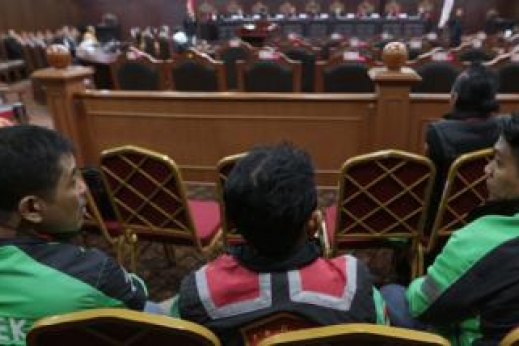
Ruling hearing of judicial review of the Road Traffic and Transportation Law (LLAJ Law), Thursday (28/6) in the Plenary Courtroom of the Constitutional Court. Photo by Humas MK/Ganie.
The petition for judicial review of Law No. 22/2009 on Road Traffic and Transportation (LLAJ Law) was rejected entirely by the Constitutional Court (MK) on Thursday (28/6) afternoon. "The verdict heard, rejects the Petitioners\' petition for the whole," said Plenary Chief Anwar Usman in the presence of the other constitutional justices.
The Petitioners, who are affiliated with to the Tim Pembela Rakyat Pengguna Transportasi Online or the Online Transportation Action Committee (KATO), reviewed Article 138 paragraph (3) of the LLAJ Law that reads, "Public transport of people and/or goods can only be done by Public Motorized Vehicles.” KATO represents 50 petitioners from various professional backgrounds—online ojek drivers, organizing committee of trade/labor unions, private employees, entrepreneurs, journalists, students, and users of the application-based (online) ojek service. In their petition, the Petitioners said that that the existence of the online ojek was an actual fact. They explained the advantages of the online ojek that not only offers transport services but also shopping as well as food ordering services. The Petitioners believed that at present, the a quo article does not provide constitutional guarantee for the Petitioners, both as users and drivers of the online ojek. On the contrary, the a quo article was seen by the Petitioners as potentially triggering a rejection to the existence of the online ojek.
In the legal considerations read by Constitutional Court Justice Arief Hidayat, the Court is of the opinion that Article 47 paragraph (3) of the LLAJ Law is a legal norm that serves to carry out social engineering so that citizens use road transport that prioritizes security and safety, both private and public motorized vehicles. Meanwhile, Article 27 paragraph (1) of the 1945 Constitution has nothing to do with motorized vehicles because the article is related to the equal position of every citizen in case of violation of law.
"Therefore, the arguments of the Petitioners that the inclusion of motorcycles in Article 47 paragraph (3) of the LLAJ Law is contradictory to Article 27 paragraph (1) of the 1945 Constitution is unreasonable according to law. Article 47 paragraph (3) of the LLAJ Law actually provides protection to every citizen when using road transport, both public and private vehicles," said Justice Arief read the Constitutional Court Decision case No. 41/PUU-XVI/2018.
He added in relation to contradiction between Article 47 paragraph (3) of the LLAJ Law and Article 28D paragraph (1) of the 1945 Constitution, according to the Court, there is no correlation between the Petitioners\' right to the recognition, guarantee, protection, and fair legal certainty and equal treatment before the law, because Article 28D paragraph (1) of the 1945 Constitution is related to the right of every citizen before the law, for example, when the Petitioners are examined by the investigator in a criminal case or when the Petitioners are settling disputes in court. Therefore, according to the Court, Article 47 paragraph (3) of the LLAJ Law is not contradictory to Article 28D paragraph (1) of the 1945 Constitution.
With respect to the Petitioners\' argument on the different treatment toward motorcycles and other motorized vehicles, the Court is of the opinion that it is inaccurate. Motorcycles are regulated in Article 47 paragraph (2) letter a of the LLAJ Law.
"However, in terms of road transport that carries goods and/or people with charge, some criteria are required in order to provide safety and security. Criteria for motorized vehicles intended to transport goods and/or people have been determined in Article 47 paragraph (2) letters b, c, and d juncto Article 47 paragraph (3) of the LLAJ Law as described in the consideration of the Court," said Justice Arief.
Therefore, based on the explanation, the Court is of the opinion that the Petitioners\' petition with regard to the unconstitutionality of Article 47 paragraph (3) of the LLAJ Law is unreasonable before the law. (Nano Tresna Arfana/LA/Yuniar Widiastuti)
Thursday, June 28, 2018 | 16:50 WIB 194