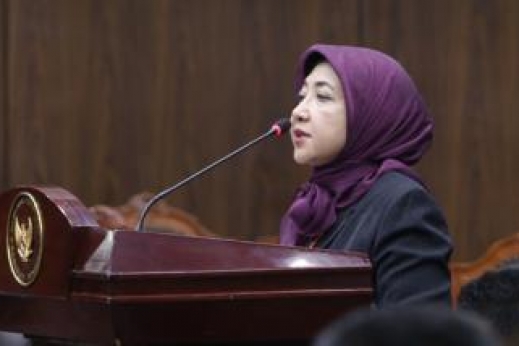
The Government\'s statement delivered by Ninik Hariwanti as the Director of Legislation Litigation of the Law and Human Rights Ministry in the judicial review of the Advocate Law on Monday (25/6) in the Plenary Courtroom of the Constitutional Court. Photo by Humas MK/Ganie.
The Constitutional Court (MK) held a follow-up session of the judicial review of Law No. 18/2003 on Advocates on Monday (25/6) afternoon. The agenda of the hearing of case No. 35/PUU-XVI/2018 was to listen to the statement of the Government, represented by Ninik Hariwanti as Director of Legislation Litigation of the Law and Human Rights Ministry.
The Government responded to the argument of the Petitioners that the provision of Article 1 number 4, Article 2 paragraphs (1) and (2), as well as a number of other articles in the Advocate Law along the phrase "advocate organizations" do not meet the constitutionality requirements of clear, solid, and complete legal norms.
"The provision of the articles being reviewed are the norm of provision of the law [that has corresponding arrangement between article one and another], so it can form a regulatory system that is adjusted to the needs of the law," said Ninik before the Panel of Justices led by the Chief Justice of the Constitutional Court, Anwar Usman.
According to the Government, the regulation of the advocate profession with several articles such as the a quo articles is a very clear and complete set of legal norms that can provide regulatory boundaries in accordance with legal requirements. The a quo articles, Ninik explained, do not contradict the constitutional foundation, instead provide for the mechanism to exercise the constitutional rights that the advocates themselves have.
The Petitioners also consider the norm of the provision of the a quo articles along the phrase of ‘advocate organizations’ multi-interpretive. In this case, the Government cited the Decision of the Constitutional Court No. 14/PUU-XIV/2016 which, in its legal considerations, including that Article 28 paragraph (1) of the Advocate Law in going toward single-bar organizations.
Ninik explained that according to the Association of Indonesian Advocates (Peradi), 8 organizations carrying temporary duties of advocate organizations—Ikatan Advokat Indonesia (Ikadin), Asosiasi Advokat Indonesia (AAI), Ikatan Penasihat Hukum Indonesia (IPHI), Serikat Pengacara Indonesia (SPI), Himpunan Advokat Pengacara Indonesia (HAPI), Asosiasi Konsultan Hukum Indonesia (AKHI), Himpunan Konsultan Hukum Pasar Modal (HKHPM), and Asosiasi Pengacara Syariah Indonesia (APSI)—still exist.
"However, the advocate profession organization authority, in terms of creating code of ethics, assessing, supervising, and dismissing advocates, vide Article 26 paragraph (1), Article 3 paragraph (1) letter f, Article 2 paragraph (2), Article 12 paragraph (1), and Article 9 paragraph (1) of the Advocate Law, is officially the authority of Peradi, which has been formed," Ninik said.
The Government asserted that the eight advocate organizations of Peradi founders still have the authority other than that of Peradi. Therefore, Ninik added, it cannot be said that Article 28 paragraph (1) of the Advocate Law negates the existence of the eight organizations, which therefore would violate the principle of freedom of association and assembly, as stipulated by the 1945 Constitution of the Republic of Indonesia, vide Decision of the Court No. 19/PUU-I/2003.
"Therefore, the Petitioners\' argument that Article 28 paragraph (1) of the Advocate Law is contradictory to the 1945 Constitution of the State of the Republic of Indonesia is unreasonable," Ninik said.
Petitioners Bahrul Ilmi Yakup and others are Indonesian individuals who work as advocates and legal consultants. The Petitioners claimed that they did not have legal certainty of legal and constitutional advocate organizations to exercise the authority set forth in the Advocate Law.
The Petitioners argue that the norm of the phrase "advocate organizations" as set forth in the Advocate Law is currently multi-interpretive, which allows certain parties such as the Congress of Indonesian Advocates (KAI) and the Association of Indonesian Advocates of the Republic of Indonesia (Peradri), or the Chief Justice of the Supreme Court of the Republic of Indonesia, to provide different interpretations or other interpretations that are unconstitutional because they do not conform to the original intent or teleological purpose of the formation of the norm of the phrase "advocate organizations" as regulated by the Advocate Law.
This can be explained by the interpretation of KAI in relation to advocate organizations in that the one entitled to exercise the authority set forth in the Advocate Law is "the Congress of Indonesian Advocates." KAI in this case intends to gather the Indonesian advocates in a single organization as mandated by the Advocate Law ex Article 10 letter a of the Deed of Establishment of the Organization of Congress of Indonesian Advocates. (Nano Tresna Arfana/LA/Yuniar Widiastuti)
Tuesday, June 26, 2018 | 18:15 WIB 253