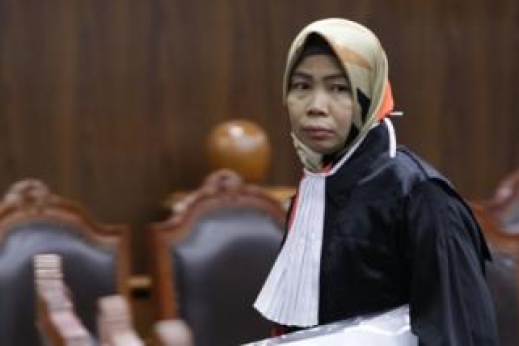
Latifah Fardiyah as legal counsel of the Petitioners after the revision hearing of judicial review of the Construction Services Law, Tuesday (26/6) in the Plenary Courtroom of the Constitutional Court. Photo by Humas MK/Ganie.
The hearing to revise the petition of judicial review of Law No. 2/2017 on Construction Services was held by the Constitutional Court (MK) on Tuesday (26/6) afternoon.
The Petitioners\' legal counsel for case No. 44/PUU-XVI/2018, Latifah Fardiyah, confirmed to the Constitutional Court that her clients have agreed to withdraw the petition. "As the legal counsel of the Petitioners, [I] have agreed with the Petitioners to withdraw the petition," said Latifah.
In relation to the petition withdrawal, the panel of justices led by Constitutional Court Justice M. P. Sitompul explained that the ruling would be on June 28, 2018. "All right. Because we have received the letter dated June 21 and today we are officially aware of the withdrawal, the ruling for the case will be pronounced on Thursday June 28, 2018, at 09.00 a.m. Well, this is a notice and an invitation to attend the hearing," he said.
The Petitioners, represented by Andi Muhammad Asrun, reviewed Article 84 paragraphs (2) and (5) of the Construction Services Law. They are individual citizens as intended in Article 51 paragraph (1) of Law No. 24/2003, who are at the board of the provincial Construction Development Agency in several regions. The Petitioners argued that the construction development agency, as stated in the public law, was formed with the legal basis of Law No. 18/1999 on Construction Services, Government Regulation No. 28/2000 on Business and the Role of Construction Services Society, and Government Regulation No. 4/2010 on Business and the Role of Construction Services Society.
According to the Petitioners, the provision of Article 84 paragraphs (2) and (5) of the Construction Services Law have given rise to uncertain future of the existence of the Construction Development Agency (LPJK) in the provinces. The a quo article may also lead to the potential loss of office assets, vehicles, finances, and information systems of construction services derived from private funding, as well as human resources, which could lead to the possibility of takeover of office assets, vehicles, finances, and information systems of construction services by the government after the establishment of the national LPJK representative that differs from the provincial LPJK. (Nano Tresna Arfana/LA/Yuniar Widiastuti)
Tuesday, June 26, 2018 | 18:52 WIB 162