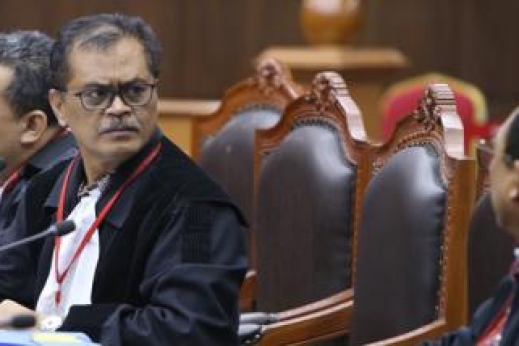
Petitioners’ legal counsel M. Asrun present with Principal Petitioners in the preliminary hearing of the judicial review of the Construction Services Law on Wednesday (6/6) in the Plenary Courtroom of the Constitutional Court. Photo by Humas MK/Ganie.
The preliminary hearing for the judicial review of Law No. 2/2017 on Construction Services was held by the Constitutional Court (MK) on Wednesday (6/6). The petition registered under No. 44/PUU-XVI/2018 was filed by Heru Cahyono and Wijaya Kusuma Prawira.
The Petitioners were represented by Andi Muhammad Asrun as legal counsel to review Article 84 paragraphs (2) and (5) of the Construction Services Law. According to the Petitioners, the provision of Article 84 paragraphs (2) and paragraph (5) of the Construction Services Law have given rise to uncertain future of the existence of the Construction Development Agency (LPJK) in the provinces as well as the potential loss of office assets, vehicles, finances, and information systems of construction services derived from private funding, as well as human resources. There would be the possibility of takeover of office assets, vehicles, finances, and information systems of construction services by the government after the establishment of the National LPJK representative.
Asrun added that the Construction Development Agency, as stated in the public law, was formed with the legal basis of Law No. 18/1999 on Construction Services, Government Regulation No. 28/2000 on Business and the Role of Construction Services Society, and Government Regulation No. 4/2010 on Business and the Role of Construction Services Society.
In addition, Asrun said that the stipulation of Article 84 paragraphs (2) and (5) of the Construction Services Law had resulted in uncertainty in the development of regional construction services due to construction services that have been done by the Construction Development Agency (LPJK) at national and provincial levels as regulated in Law No. 18/1999. The loss of LPJKP\'s role at the national and provincial levels resulted in the bureaucratization of registration and certification process for construction services, so the process could become time-consuming and cause inefficiency.
Therefore, in the petitum, the Petitioners requested that the phrase in Article 84 paragraph (5) of the Construction Service Law that reads "The executives of the institution as referred to in paragraph (3) are determined by the Minister after obtaining approval from the People\'s Legislative Assembly" be declared contradictory to the 1945 Constitution and has no legal power as long as it is not interpreted as “The executives of the institution as referred to in paragraph (3) are determined by the Minister after obtaining the approval of the People\'s Legislative Assembly at the national level and are determined by the Governor after obtaining the consent of the Regional People\'s Legislative Assembly at the regional level."
Legal Standing
Responding to the arguments of the Petitioners, Constitutional Court Justice M. P. Sitompul highlighted the legal standing of the Petitioners. He requested that the Petitioners clarify their legal standing because although the Petitioners are individual Indonesian citizens, they were acting under a public legal entity.
"[You are] under this public law because it is based on Article 33 paragraph (1). The question that may also be explained in this petition is whether the provincial LPJK already exists in every province in Indonesia? Because, I see that this petition was only filed from East Kalimantan, South Kalimantan, so it is also necessary to elaborate further on the matter under the aforementioned public law," Justice Manahan advised as chairman of the hearing.
Meanwhile, Constitutional Justice Maria Farida Indrati observed the argument of the Petitioners regarding the contradiction between the Construction Service Law and Law No. 18/1999. According to her, the Petitioners had not clearly explained the differences between the two.
"Although the Constitutional Court does not [conduct inter-legislation reviews], and although the other law has been revoked, what\'s the loss? Because here you explain about the old law, and then the government regulation, but using a government regulation. Then what about the position of LPJKP? [It is not explained in the petition," she said. (Nano Tresna Arfana/LA/Yuniar Widiastuti)
Friday, June 08, 2018 | 08:37 WIB 179