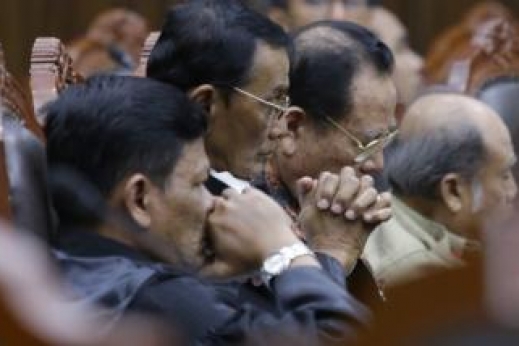
Petitioner Risof Mario and Martinus P. H. Butar Butar listening to the judicial review hearing of Law Number 7 of 2017 on General Elections on Wednesday (23/5) in the Courtroom of the Constitutional Court. Photo by Humas MK/Ifa.
The petition for judicial review of Law No. 7/2017 on General Elections (Elections Law) was not accepted. Such is the decision of the Constitutional Court (MK) on the petition of Case No. 33/PUU-XVI/2018 proposed by Martinus P. H. Butar Butar and Risof Mario.
"The verdict hears, declares the petition of the Petitioners unacceptable," said Plenary Chairman Anwar Usman accompanied by other constitutional justices in the ruling hearing on Wednesday (23/5) afternoon.
The Petitioners review Articles 169, 227, and 229 of the Elections Law that they deem detrimental to their constitutional rights because they do not include the Regional Representatives Council (DPD) in the determination of the Presidential and Vice Presidential Candidates. In their petition, the Petitioners argue that history has given the constitutional rights of all the people, namely the indigenous Indonesian people, which are recognized in the 1945 Constitution, through regional delegates, that later metamorphosed into the DPD. They claimed that the Elections Law had impaired their constitutional rights. They claimed that the requirements for the presidential and vice presidential candidates has violated and do not comply with the Preamble of the 1945 Constitution. They added that the 1945 Constitution is the result of a long struggle, resistance, and war of the Indonesian people, which by the 1945 Constitution is believed to be the community of indigenous Indonesians. Such violation, according to the Petitioners, constitutes an override of the right of indigenous Indonesian people in determining the nation\'s leaders, because it does not accommodate the constitutional position of the indigenous Indonesian people as regulated in Article 26 of the 1945 Constitution, which recognizes the history of the establishment of the Indonesian state by indigenous Indonesians.
In the legal considerations read by Constitutional Justice Saldi Isra, the Court considered the Petitioners not harmed by the enactment of Article 227 and Article 229 of the Elections Law. The norm of Article 227 is requirements that must be fulfilled by presidential and vice presidential candidate pairs. Whereas Article 229 is related to the administrative requirements that must be submitted by the political parties and/or combinations of political parties that will register the presidential and vice presidential candidate pairs to the Elections Commission.
Justice Saldi continued, the Court is of the opinion that considering the substance of the norms in both a quo articles, it became clear that the Petitioners were unable to prove their constitutional rights and/or authority granted by the 1945 Constitution and that the constitutional rights and/or authority are deemed by the Petitioners to be disadvantageous by their enactment of the norms in Article 227 and Article 229 of the Elections Law as required in explaining their legal standing.
"Thus, there is no doubt at all for the Court to declare that the enactment of the norms in both articles does not impair the constitutional rights of the Petitioners," Justice Saldi declared.
With regard to the arguments of the Petitioners who requested that the provisions of Article 227 and Article 229 of the Elections Law be interpreted that each candidate pair should receive votes from 50% + 1 members of the Regional Representatives Council (DPD) in order to for the presidential and vice presidential candidate pairs to maintain the identity of Indonesia in the Unitary State of the Republic of Indonesia, the Court considered such interpretation further corroborated the evidence that the Petitioners had no legal standing in submitting the petition. In addition, as stipulated in Article 22D of the 1945 Constitution, DPD has no authority whatsoever in the process of submitting presidential and vice presidential candidates and the Petitioners in the a quo case are not DPD members, but individual citizens.
Therefore, the Court is of the opinion that the Petitioners are not the legal subject of the owner/holder of the constitutional rights as regulated in Article 22D of the 1945 Constitution. Based on such considerations, the Court is of the opinion that the Petitioners do not have the legal standing to file the petition. (Nano Tresna Arfana/LA/Yuniar Widiastuti)
Wednesday, May 23, 2018 | 14:45 WIB 163