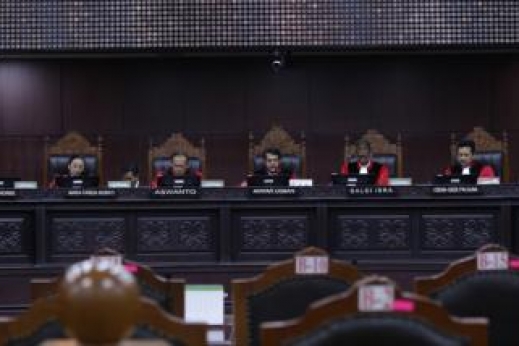
Constitutional Court Justices held a ruling hearing of the judicial review of Law No. 8 of 1981 on the Criminal Procedure Code (KUHAP), on Wednesday (23/5) in the Constitutional Court Room of the Constitutional Court. Photo by Humas MK/Ifa.
The Constitutional Court rejected the Petitioner’s petition for judicial review of Law No. 8/1981 on the Criminal Procedure Code (KUHAP) entirely. The ruling hearing of case No. 4/PUU-XVI/2018 was read out by Chief Justice Anwar Usman on Wednesday (23/5) in the Plenary Courtroom of the Constitutional Court.
"The verdict heard, rejects the Petitioner’s petition for the whole," Justice Anwar said in the ruling hearing on the case petitioned by Sutarjo, a lawyer.
The Petitioner argued that the form of protection of one\'s dignity manifests, among others, by the guarantee of the right of a person not to be arbitrarily arrested and detained. As stipulated by Article 9 of the Universal Declaration of Human Rights (UDHR) 1948. According to the Petitioner, detention is the deprivation of a person\'s of freedom, and that legislators should provide control over law enforcement officials in the event of detention in order to avoid human rights violations. When a suspect does not hinder the investigation, does not escape, investigators or public prosecutors can still detain them. In fact, the authority of detention is often used for transaction, depending on whether the investigator or the prosecutor detains the suspect or not. The suspect is [often] not granted the right to defend himself against arrest.
In the legal considerations, Constitutional Justice Suhartoyo described that in the perspective of human rights as universally recognized rights. In essence, there are certain restrictions imposed on the State so that the ultimate rights of the citizens are protected from the arbitrariness of power. Furthermore, he explained, although detention is essentially a form of indirect protection of the rights of the people, officials who have the authority to carry out detention are required to act very carefully. "Therefore, the actual [emphasis] of detention in the judicial system including in Indonesia is that a new action can be declared valid if it fulfills certain conditions," he explained.
Justice Suhartoyo added that although the Petitioner’s argument was limited to the issue of detention by reserve investigators or investigators and public prosecutors, the Court was of the opinion that it continues to question the nature of the act of detention itself. On this, the Court had considered the highly strict conditions and caution by the authorities to detain at each level are excessive concern. Even if there were transactional practices as argued by the Petitioner, he added, they are a matter of implementation, which depends on the integrity of its officials, which is irrelevant that the Petitioner associated it with the unconstitutionality of norms of those articles. "Actually, the control mechanism that the Petitioner is concerned about is not absent, because the law has provided the means for it juridically," Justice Suhartoyo said.
The Meaning of Detention
Furthermore, the Court affirmed that although the petition only concerns with part of the norm of Article 7 paragraph (1) letter d along the word "detention," Article 11 along the sentence "except for the imprisonment which must be granted with the delegation of authority from the investigator," and Article 20 paragraphs (1) and (2) of the Criminal Procedure Code, what the Petitioner challenge is the meaning of detention.
With regard to another opinion of the Petitioner who argued that even for seizure there is a control function, while detention that is in the form of limitation of people\'s freedom and a highly sensitive human right issue there is no control mechanism, the Court was of the opinion that confiscation of immovable objects shall be preceded by approval of the Head of the District Court because the right does not necessarily proves ownership by the suspect or defendant suspected of committing a crime. The confiscation of a moving object may be carried out without the approval of the Head of the District Court because on the moving object the principle of Article 1977 of the Civil Code is in effect.
"Thus, the Petitioner’s argument that compares the act of detention and confiscation is irrelevant. Therefore, the existence of detention does not mean there is no control mechanism, but indeed there is, namely pretrial institutions that include testing the validity of confiscation," said Justice Suhartoyo. (Sri Pujianti/LA/Yuniar Widiastuti)
Wednesday, May 23, 2018 | 15:02 WIB 271