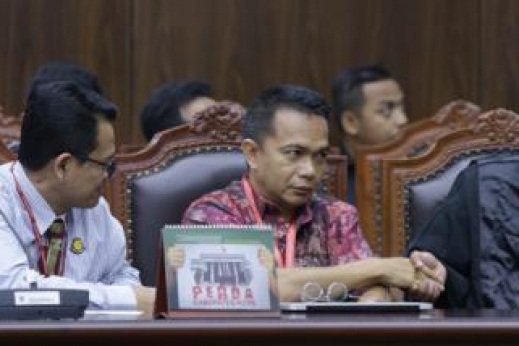
The Petitioners’ attorney attending the judicial review hearing of the Law on the Juvenile Justice System on Wednesday (22/5) in the Courtroom of the Constitutional Court. Photo by Humas MK/Ifa.
The Constitutional Court granted entirely the petition on to criminal sanctions against the prosecutor who committed maladministration as stated Law No.11/2012 on Juvenile Justice System (SPPA). The decision No. 68/PUU-XV/2017 was read by Chief Justice Anwar Usman on Wednesday (22/5) in the Plenary Courtroom of the Constitutional Court.
"Grants the Petitioners\' petition. Declares that Article 99 of Law No.11 of 2012 on Juvenile Justice System is contradictory to the 1945 Constitution of the State of the Republic of Indonesia and has no binding legal force," Anwar said, reading the decision for the petition filed by Noor Rachmat and others, who work as prosecutors.
The Petitioners argue that their constitutional rights are violated by the enactment of Article 99 of the SPPA Law. Article 99 of the SPPA Law reads, " Public Prosecutor who deliberately neglect his/her obligations as referred to in Article 34 paragraph (3) shall be punished with imprisonment of maximum 2 (two) years ." According to the Petitioners, Article 99 of the SPPA Law has the potential to convict public prosecutors who conduct maladministration in exercising their authority in a juvenile case. The article is considered intervening the independence of prosecutors, when administrative misconducts of a prosecutor should be accountable to their superiors in the structure and level of supervision been provided by the legislation as stipulated in the Attorney General Law. In addition, the Petitioners considered that convictions for administrative violations should not be monitored and corrected by the judiciary, in this case is criminal justice. Correctional supervision by a criminal justice for such offense can be regarded as intervention by power. Therefore, the Petitioners requested that the Constitutional Court revoke the enforcement of Article 99 of the SPPA Law.
In the legal considerations read by Constitutional Justice Maria Farida Indrati, on the criminal sanction, the Court has given considerations in the Decision of the Constitutional Court No. 110/PUU-X/2012 dated March 28, 2013 on Article 96, Article 100, and Article 101 of the SPPA Law, which determine the criminal sanction to special officials in the implementation of SPPA, namely judges, court officials, investigators, and public prosecutors. According to the Court not only they do not formulate constitutional provisions on independence of the judiciary and of the relevant special officials (judges, prosecutors, and child crime investigators), which mean providing legal guarantees for the administration of an independent judiciary, but they have also criminalized the administrative violations in the implementation of SPPA, which would have negative impacts on the special officials who run SPPA. The negative impacts are unnecessary psychological impacts such as fear and anxiety in the implementation of their duties in trying a case.
"Such matters create legal uncertainty and injustice, which is contradictory to Article 28D paragraph (1) of the 1945 Constitution and counterproductive with the intention of conducting SPPA with its diversity effectively and efficiently in the framework of restorative justice," said Justice Maria.
Then, Justice Maria asserted that the judicial power should not be influenced by both the executive and legislative. Here, she added, the judicial supremacy principle that regulates the two branches of state power must be subject to court decision. Such affirmation is important because if it is related to the essence of the Petitioners\' petition that requested that its principle of independence while carrying out the prosecution function in a criminal case involving the child and the judicial process through the SPPA be declared equal with that of the judge. Therefore, she continued, along the limited reasons mentioned, the Court could understand and consider it.
Justice Maria added that if we look closely at the substance in question concerning the administrative duty naturally is the duty of the prosecutor as the public prosecutor in implementing the judge\'s determination. "Therefore, it is the duty of the prosecutor or public prosecutor who is supposed to carry out the judge’s decision, including carrying out his own decision in the act of detaining or releasing prisoners in the a quo case is an act of detention of a child," she explained.
Shall Not Exceed the Time Limit
Justice Maria added that even though the Court had declared the petition being petitioned unconstitutional, it does not mean allowing officials who perform the duties to release a child from detention violate the specified time limit. That is because, she continued, it is the same as deliberately depriving one\'s of their liberty.
In other words, she explained, the intention not to release the detained child in time does not eliminate the right of every person who is harmed by the deliberate action by every official, including law enforcers, on deprivation of one’s liberty to be able to file a lawsuit over such action based on the provision of Article 333 paragraph (1) of the Criminal Code that reads, "Any person who deliberately and unlawfully deprives someone or keeps someone deprived of his liberty, shall be punished by a maximum imprisonment of eight years." "Based on all considerations mentioned above, according to the Court, the Petitioners\' petition is reasonable according to the law," she declared. (Lulu Anjarsari/Yuniar Widiastuti)
Wednesday, May 23, 2018 | 14:59 WIB 185