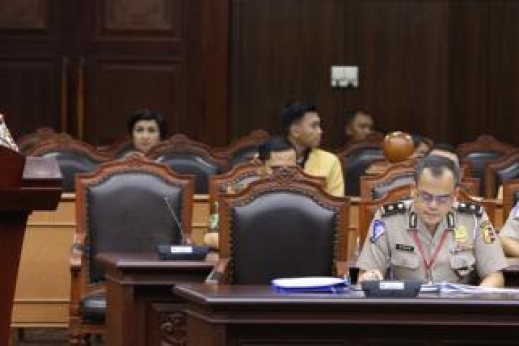
Statement of the Relevant Party delivered by the Director of Security and Safety of the National Police Traffic Corps, Brigadier Chryshnanda Dwilaksana, in the judicial review hearing of the Law on Road Traffic and Land Transportation (LLAJ) on Wednesday (25/4) in the Plenary Courtroom of the Constitutional Court. Photo by Humas MK/Ganie.
The prohibition against activities such as using GPS while driving on the road is intended to implement the concept of security and order as mandated by Article 30 paragraph (4) of the 1945 Constitution. This was conveyed by the Director of Security and Safety of the National Police Traffic Corps, Brigadier Chryshnanda Dwilaksana, as the Relevant Party in the judicial review hearing of Law No. 22/2009 on Road Traffic and Land Transportation (LLAJ Law). The third hearing of case No. 23/PUU-XVI/2018 was held on Wednesday (25/4) in the Plenary Courtroom of the Constitutional Court.
Chryshnanda stated that the LLAJ Law has firmly mandated to the Police as one of the stakeholders to take an active role in the effort to overcome road traffic accidents in accordance with the existing authority. In addition, he added, the role is reinforced by the National Police Law that requires the police to protect the community, including on the road. Therefore, the Police always conducts evaluation to determine effective measures in order to suppress the number of traffic accidents. "Thus, the phrase ‘using telephone’ including other activities that interfere with concentration when driving a motor vehicle on the road is clear and cannot be called a unilateral desire of law enforcement officers," he explained.
Following Traffic Regulations
In addition, Chryshnanda also explained that the provision of criminal sanctions as set forth in Article 283 of the LLAJ Law is not intended as a revenge attempt by law enforcers to persons who have committed a crime, but rather has certain purposes. On the one hand, criminalization is intended to improve the attitude of the convicted person and also to prevent others from committing a similar crime or becoming a victim of a criminal offense. Criminal sanctions are intended to encourage every driver to drive properly and correctly in accordance with traffic regulations so that they do not cause traffic accidents. "The driver is not an actor who can threaten the safety of himself and other road users," he explained.
Affecting Drivers
Meanwhile, Expert Staff for Law and Transportation Bureaucratic Reform of the Ministry of Transportation, Umar Aris, representing the Government, stated that GPS use while driving is a combination of simultaneous driving activities, including thought process, visualization to process information from the GPS, and observing road conditions as well as traffic. As a result, it may affect the driver\'s ability to drive.
With regard to the case petitioned by the Toyota Soluna Community (TSC) and the individual petitioners, Umar said that the context of Article 106 paragraph (1) of the LLAJ Law along the phrase "thereby affecting the ability in driving the Vehicle" is sufficient to explain that the use of phone and its features is not prohibited, as long as the driver is not driving a vehicle [while using the phone]. "So the reasons presented by the Petitioners [are not] fundamental because GPS is only one feature on the smart phone," said Umar in the hearing led by Chief Justice Anwar Usman.
Violation of Article 106 paragraph (1) of the LLAJ Law is threatened with criminal sanctions, Umar asserted, as stipulated in the provision of Article 283 of the LLAJ Law as a logical consequence of the actions of a person who neglects the proper and correct traffic regulations, threatening other road users. "Therefore, on all objections of the Petitioners, the Government declares the elucidation to Article 106 paragraph (1) of the LLAJ Law having provided legal certainty in accordance with the development of the time and not contradictory to Article 1 paragraph (3) and Article 28D paragraph (1) of the 1945 Constitution," explained Umar.
The Petitioners felt that their constitutional rights had been impaired by the enactment of Article 106 paragraph (1) and Article 283 of the LLAJ Law. They considered the provisions conditionally contradictory to the 1945 Constitution, especially Article 1 paragraph (3) and Article 28D paragraph (1). The Petitioners reasoned that the phrase "using telephone" in the Elucidation to Article 106 paragraph (1) of the LLAJ Law was one of the reasons causing disturbance do driving concentration of motorists should have a clear purpose. Thus, there would be no multiple interpretations in its enforcement.
Before ending the hearing, Justice Anwar reminded all parties that the following hearing would be held on Wednesday, May 9, 2018 at 11:00 a.m. to hear expert statement for the Petitioners. (Sri Pujianti/LA/Yuniar Widiastuti)
Wednesday, April 25, 2018 | 18:35 WIB 198