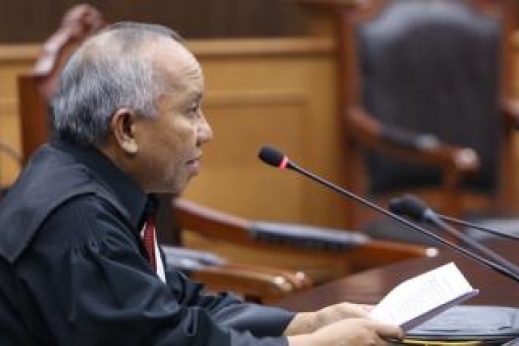
Dahlan Pido as attorney of the Petitioner delivering the principal points of the revision of the petition for judicial review of the State Administrative Court Law on Monday (9/4) in the Plenary Courtroom of the Constitutional Court. Photo by Humas MK/Ganie.
Director of PT Timsco Indonesia S. A. Habibie improved the petition for judicial review of Law No. 5/1986 on State Administrative Courts (PTUN) as amended by Law No. 9/2004 and Law No. 51/2009 (State Administrative Court Law). The second hearing presided over by Constitutional Justice Manahan M.P. Sitompul was held on Monday (9/4) in the Plenary Courtroom of the Constitutional Court.
In the petition revision, the Petitioner, represented by Dahlan Pido, explained that he had revised the petition related to the review of the phrase "ninety days" in Article 55 of the Administrative Court Law. Article 55 of the Administrative Court Law reads, “A lawsuit may be filed within a period of ninety days commencing on the date on which the Decree of the Board or State Administrative Officer was received or promulgated."
Dahlan said that as a third party, the Petitioner was harmed by the existence of the a quo article because they did not receive the decision of the administrative court right away. Based on Article 55 of the Administrative Court Law, the grace period for a litigant to file a lawsuit is 90 days since the administrative court decision was announced. Meanwhile, for a third party not directly related to the case such as the Petitioner, the grace period of 90 days has the potential to harm the third party who actually has an interest in the issuance of the administrative court decision.
"However, a third party such as the a quo Petitioner does not know for sure when the administrative court decision is announced. It is actually the right of every person to file a lawsuit, but why is it a problem for the a quo Petitioner? The grace period as set forth in Article 55 is a very short period. This triggers legal uncertainty and disrupted the process for justice seekers as experienced by the Petitioner," he explained in relation to the petition No. 22/PUU-XVI/2018.
Previously, in his petition, the Petitioner considered the phrase "ninety days" in Article 55 of the Administrative Court Law impairing his constitutional rights. The phrase states conceptually the period of 90 days in the State Administrative Court Law is very short, especially when compared to the provisions of civil complaint time limits, especially the those of articles 835, 1963, and 1967 of the Civil Code whose time limit is 30 years.
In addition to the short period of time, the Petitioner also views the a quo norm as incurring substantial expenses in filing land ownership claims. So lawsuit deadline in the administrative courts is absolutely extended as stipulated by the Supreme Court Circular (SEMA) Number 2/1991, which regulates the extension of the grace period to file claims in the administrative courts.
Furthermore, the Petitioner explained that in his case the provisions are not clear about the expiry of the lawsuit, a provision specifies a 90-day deadline (Article 55 of Law No. 5/1986), but another specifies more than 4 months (Article 3 paragraph (3) of Law No. 5/1986), and there is even a provision that states one can file a lawsuit at any time as long as there is loss suffered (SEMA No. 2/1991). The lack of synchrony between laws and regulations leads to legal uncertainty. Therefore, the Petitioners appealed to the Constitutional Court that the phrase "ninety days" in Article 55 of Law No. 5/1986 be declared contradictory to the 1945 Constitution and having no binding legal force in order to reach norms harmony on grace period as stipulated in SEMA No. 2/1991. (Sri Pujianti/LA/Yuniar Widiastuti)
Tuesday, April 10, 2018 | 17:58 WIB 224