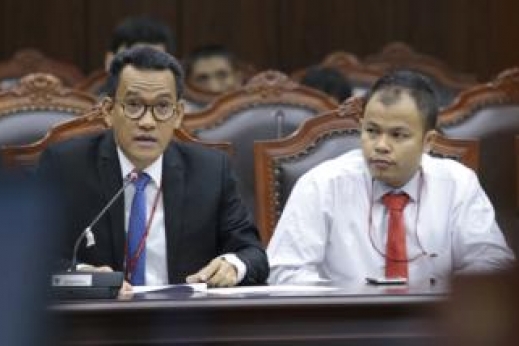
Refly Harun as attorney of the Petitioner explaining the principal points of the petition in the preliminary judicial review hearing of the Law on the Nationalization of Dutch-Owned Companies (Nationalization Law), Monday (9/4) in the Courtroom of the Constitutional Court. Photo by Humas MK/Ifa.
The Executive Board of the West Java Christian Secondary Education Foundation (BPSMK-JB Foundation) submitted a judicial review of Law No. 86/1958 on the Nationalization of Dutch-Owned Companies (Nationalization Law) on Monday (9/4). The petition registered to the Constitutional Court Registrar as No. 27/PUU-XVI/2018 reviews Article 1 of the Nationalization Law on the nationalization of Dutch-owned companies.
According to the Petitioner represented by Soekendra Mulyadi as Chairman and Toto Lukito Sairoen as Secretary, Article 1 of the Nationalization Law harms the constitutional rights of the Petitioner. Article 1 of the Nationalization Law reads, "Dutch-owned companies within the territory of the Republic of Indonesia that shall be stipulated by a Government Regulation shall be subject to nationalization and declared to be the full and free property of the State of the Republic of Indonesia."
The Petitioner is the legal owner of the land or assets owned by Het Cristhelijk Lyceum (HCL) located at Jalan Ir. H. Juanda No. 93, Bandung. However, since 1991 to 2018, the Petitioner faced a lawsuit from the Christian Lyceum Society claiming to be the owner of the HCL assets that had been nationalized by the government when, in fact, the Ministry of Finance has relinquished state control over the foreign-owned land assets to the BPSMK-JB Foundation on December 19, 2003.
However, Article 1 of the Nationalization Law has caused the foundation to often facing legal challenges. Article 1 of the Nationalization Law does not provide legal certainty for nationalized assets formerly owned by HCL that have been nationalized and transferred from the state to the Petitioner.
"Then these assets were sued several times by other parties, ranging from civil, criminal, and state administrative lawsuits. This means there is no legal protection and no fair legal certainty," said Refly Harun as the attorney of the Petitioner.
Refly refers to the Bremen Tobacco Case that was decided on February 23, 1959, which was won by Indonesia. He referred to the ruling that affirms that the nationalization of the state for the public interest is legitimate and should not be a dispute in court. In addition, to provide legal certainty to the state as well as to buyers of nationalized assets such as the Petitioner, the existence of the word "free" in Article 1 of the Nationalization Law should not be interpreted as "free" only in the context of state ownership and control, but also "free" from all legal demands and lawsuits.
Therefore, in the petitum, the Petitioner requested that the Court declare the word "free" in the provision of Article 1 of the Law on Nationalization not having a conditionally unconstitutional binding force if it is not interpreted as "Free from all legal demands and lawsuits."
Elaboration of Legal Certainty
In response to the request, a panel of justices led by Constitutional Court Justice Arief Hidayat suggested revisions. Constitutional Justice Aswanto requested that the Petitioner elaborate further on the constitutional impairment it suffered. It was also recommended for the Petitioner’s argument related to the word "free" that is considered to have no legal certainty. "How is the legal uncertainty? Of course we hope that the legal uncertainty referred to by the Petitioner is that that implies the impairment of constitutional rights, not material losses," he advised.
Meanwhile, Constitutional Justice Arief Hidayat asked the Petitioner to strengthen the posita section, for example by strengthening the references on nationalization. He stated that the Petitioner could elaborate the theory about nationalization, its impacts, and what can be nationalized. He mentioned that so that the Panel of Justices would have a complete picture of the existing petition. "Can there be any comparison in Indonesia experienced by any company or experienced by other legal subjects on nationalization? That is so we get a complete picture of this petition," he explained. (ARS/LA/Yuniar Widiastuti)
Tuesday, April 10, 2018 | 18:26 WIB 163