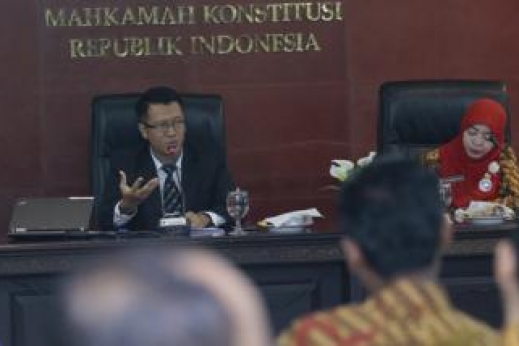
Constitutional Court researcher Irfan Nur Rahman delivering his presentation to the North Jakarta Teachers Association (MGMP), Thursday (22/2). Photo by Humas MK/Ifa.
The North Jakarta Teachers Association (MGMP) visited the Constitutional Court on Thursday (22/2/2018). They intended to improve the teachers’ understanding of the Constitutional Court and also the Indonesian constitutionalism in general. Court researcher Irfan Nur Rahman welcomed the group of 37 in the hall. First, Irfan said that the Constitutional Court was "nothing new" in Indonesia. "The initial ideas regarding the Constitutional Court can be traced since the time leading up to the independence," he explained.
During a session of the Investigating Committee for Preparatory Works for Independence (BPUPK), Mohammad Yamin first proposed a Supreme Court for reviewing laws. The idea was rejected by Soepomo the Constitution did not follow trias politica and because there were not many qualified law graduates at that time. Moreover, at that time traditional and Islamic laws were still strong in society.
The idea was re-introduced during the Reform era, leading to the establishment of the Constitutional Court through the third amendment to the 1945 Constitution. The Supreme Court was finally not given the judicial review authority, “For fear that the Supreme Court would not be able to perform the new role optimally. In addition, the level of public trust in the Supreme Court at that time was not high,” Irfan explained.
Irfan also elaborated four authorities and one obligation of the Constitutional Court. The authorities are the judicial review of laws against the 1945 Constitution, the resolution of interagency authority dispute, the resolution of legislative and presidential election result dispute, and the dissolution of political parties. One obligation granted to the Court is deciding on the House’s opinion of alleged violation committed by the president and/or vice president.
In addition, Irfan explained the fundamental differences between the Constitutional Court and the Supreme Court. The Constitutional Court examines norms and not concrete cases, whereas the Supreme Court examines concrete cases. On the other hand, the Constitutional Court’s decisions are final and binding so that it cannot be appealed as can the Supreme Court’s decisions.
After the discussion, the teachers visited the Constitution History Center (Puskon) to see the history of the Indonesian Constitution. (ARS/LA)
Translated by: Yuniar Widiastuti
Thursday, February 22, 2018 | 18:04 WIB 290