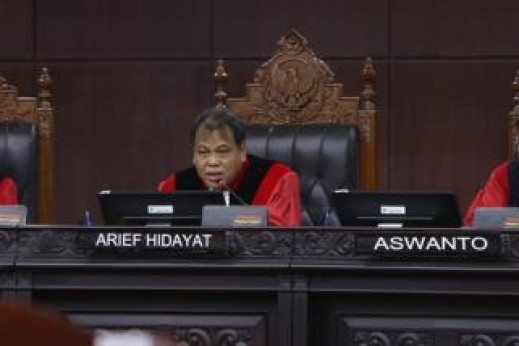
Plenary ruling hearing of the Corruption Eradication Commission Law, Wednesday (21/2) in the Plenary Courtroom of the Constitutional Court. Photo by Humas MK/Ganie.
The Constitutional Court (MK) decided on the petition for judicial review of Law No. 30/2002 on the Corruption Eradication Commission (KPK Law) petitioned by former Chairman of the House, Setya Novanto, unacceptable. "The verdict heard, stated the Petitioner\\'s petition unacceptable," said Plenary Chairman Arief Hidayat in the presence of the other constitutional justices in court ruling on Wednesday (21/2) afternoon.
Petitioner of Case No. 95/PUU-XV/2017 requested that the enactment of Article 46 paragraph (1) of the KPK Law not be applied to the Petitioner. This was because the Petitioner is Chairman/member of the House of Representatives (DPR) who must be protected when exercising his right, which is implementation in performing his functions as House Chairman/member, that is the right to ask questions, to propose recommendations and opinions, and to immunity. Therefore, the provisions of Article 46 paragraph (1) of the KPK Law cannot necessarily be applied to the Petitioner, particularly in subpoena and inquiry for investigation without the approval from President, and cannot request to the Court that the a quo article shall not apply to House members in corruption cases without approval from the President.
In the legal considerations read by Constitutional Justice Suhartoyo, the Court considered the Petitioner\\'s argument unreasonable. In accordance with the facts, he added, in the hearing, subpoena and inquiry by KPK against the Petitioner is related to the investigation on the alleged corruption case in the procurement of e-ID card for Fiscal Year 2011 -2012. The matter, according to the Court, was included in special crime as regulated in Article 245 paragraph (3) letter c of Law No. 17/2014. Therefore, in fact there is no question of constitutionality of the norm against Article 46 paragraph (1) of the KPK Law.
"With the elaboration of such considerations, there is no constitutional issue against the norm of Article 46 paragraph (1) of the KPK Law. Therefore, the Petitioner\\'s argument, who felt or at least considered himself constitutional impaired by the enactment of the a quo article did not actually occur. Therefore, the Court is of the opinion that the Petitioner does not have the legal standing to file the a quo petition," said Constitutional Justice Saldi Isra who read the opinion of the Court.
Losing Relevance
Meanwhile, on the petition of Case No. 96/PUU-XV/2017 that was also filed by Setya Novanto, the Court declared it unacceptable. In the legal considerations read by Constitutional Justice Saldi Isra, the Court obtained the fact, during overseas travel ban based on the request of KPK on April 10, 2017, that the Petitioner was not yet declared a suspect undergoing investigation process, also when there was a request for overseas travel ban based on KPK\\'s request on October 3, 2017.
So, according to the Court, Saldi added, the Petitioner could argue with the assumption that he had suffered constitutional impairment due to the provisions of Article 12 paragraph (1) letter b of the KPK Law. However, after the Court read the petition carefully, [it was found that] the petition had been filed after the Petitioner was declared a suspect. Even now he has been declared defendant undergoing trial at the Corruption Court of Jakarta. Therefore, according to the Court, the Petitioner has lost jos relevance to argue constitutional impairment due to the provisions of Article 12 paragraph (1) of the KPK Law.
"Based on the whole elaboration of the considerations, the Court is of the opinion that the Petitioner not have the legal standing as Petitioner in reviewing the a quo law," Justice Saldi said. (Nano Tresna Arfana/LA/Yuniar Widiastuti)
Wednesday, February 21, 2018 | 16:57 WIB 203