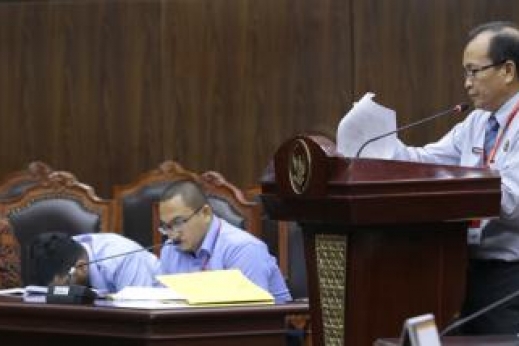
Junior Attorney General for Civil and State Administration, Oktavianus, representing the government to deliver statement in the judicial review hearing of the Criminal Procedure Code (KUHAP) on Thursday (15/2) in the Courtroom of the Constitutional Court. Photo by Humas MK/Ifa.
The authority of law enforcement over investigation to examination and detention of a suspect or defendant as stipulated in the Criminal Procedure Code (KUHAP) is in line with the principle of a fair and just legal process. This was conveyed by the Junior Attorney General for Civil and State Administration, Oktavianus, in a follow-up hearing of petition for judicial review of Article 20 paragraphs (1) and (2) of Law No. 8/1981 on the Criminal Procedure Code (KUHAP) on Thursday 15/2) in the Courtroom of the Constitutional Court.
In a statement representing the Government, Oktavianus explained that the authority to hold suspects or defendants requires strict terms, so that such enormous power not be abused. Later, such conditions may provide human rights protection and not harm the suspects or defendants.
On the Petitioner\\'s argument that he was not granted the right to defend himself against arrest, the Government was of the opinion that this was not true. The Government claimed a suspect or defendant would not be detained if it did not meet the provisions of the a quo article and there were no circumstances as referred to in Article 21 paragraph (1) of the Criminal Procedure Code. In addition, he added, the Petitioner had been given legal certainty for suspension of detention as regulated in Article 31 paragraph (1) of the Criminal Procedure Code. The legal action that may be taken by the Petitioner was to have a defense through pretrial.
"On this, by observing the Petitioner’s petition that it is no longer related to the amendment of the substance of the provisions of the a quo article, but to the change in the criminal law system, it is not appropriate if the system of change is submitted to the Constitutional Court. So, it will be appropriate if the aspirations of the Petitioner’s petition are submitted to the team discussing the latest draft of the Criminal Procedure Code," Oktavianus explained before Chief Justice of the Constitutional Court, Arief Hidayat, as chairman of the hearing.
Oktavianus also questioned the legal standing of the Petitioner. According to him, no rights and/or authority of the Petitioner were violated or are potentially violated by the enactment of the a quo article. "Therefore, the Government is of the opinion that there is no constitutional impairment suffered by the Petitioner due to the enactment of the a quo article," he explained.
The petition No. 4/PUU-XVI/2018 questions the authority of detention. The Petitioner reviews Article 20 paragraphs (1) and (2) of the Criminal Procedure Code. Article 20 Paragraph (1) of the Criminal Procedure Code reads, "In the interest of investigation, the investigator or assistant investigator on order of the investigator as intended in Article 11 has the authority to make a detention." Article 20 paragraph (2) reads, "In the interest of prosecution, he public prosecutor has the authority to make a detention or further detention."
Previously, Sutarjo, a lawyer, filed the petition because of his detention by the East Java Police investigators. Previously, the Petitioner reported Mashudi, a notary public (PPAT), regarding dispute on the sale and purchase of brackish water land involving the Petitioner’s client. Afterwards, the Petitioner received an arrest warrant because Mashudi had reported him and his client for alleged fraud and/or slander and/or false complaint. The Petitioner argues that the form of protection of one\\'s dignity manifests, among others, by the guarantee of the right of a person not to be arbitrarily arrested and detained. As stipulated by Article 9 of the Universal Declaration of Human Rights (UDHR) 1948. According to the Petitioner, detention is the deprivation of a person\\'s of freedom, and that legislators should provide control over law enforcement officials in the event of detention in order to avoid human rights violations. When a suspect does not hinder the investigation, does not escape, investigators or public prosecutors can still detain them. In fact, the authority of detention is often used for transaction, depending on whether the investigator or the prosecutor detains the suspect or not. The suspect is [often] not granted the right to defend himself against arrest.
At the end of the trial, Chief Justice of the Constitutional Court Arief Hidayat said that the hearing will be continued on Monday, March 5, 2018 at 11:00 a.m. with the agenda to hear the Expert from the Petitioners.
Thursday, February 15, 2018 | 16:18 WIB 279