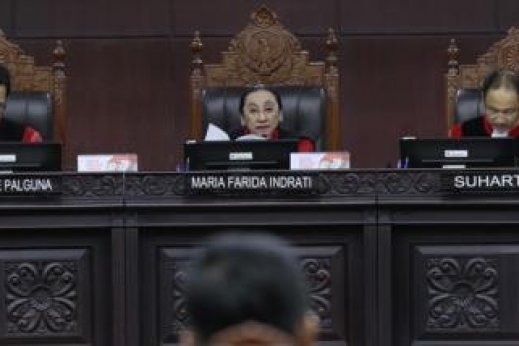
Panel Hearing of petition revision for judicial review of Criminal Procedure Code (KUHAP), Monday (29/1) in the Courtroom of the Constitutional Court. Photo by Humas MK/Ifa.
The revision hearing of judicial review of Article 20 paragraphs (1) and (2) Law No. 8/1981 on the Criminal Procedure Code (KUHAP) was held by the Constitutional Court on Monday (29/1). The Petitioner\'s attorney, Muhammad Sholeh, submitted a number of revisions to the petition.
"We revised several things. First, the petition originally only [challenged] Article 20 paragraphs (1) and (2), we added Article 7 paragraph (1) letter d along the word “detention.” We also added Article 11 of the Criminal Procedure Code along the sentence \'except for the imprisonment which must be granted with the delegation of authority from the investigator\'. This is related to the articles petitioned, "said Muhammad Sholeh to the Panel of Justices led by Constitutional Justice Maria Farida Indrati.
Subsequently, the Petitioner includes Article 38 paragraph (1) of the Criminal Procedure Code,"Confiscation can only be carried out by an investigator with a warrant from the chairman of the local district court."In addition, the Petitioners also added Article 38 paragraph (2) Criminal Procedure Code to review, which reads, "In a very needy and urgent situation, if an investigator has to act immediately and cannot possibly obtain a warrant first, without mitigating the provision of section (1) the investigator can only confiscate movables, for which purpose he has to report immediately to the chairman of the local district court to get his approval.”
"The question is, if in the confiscation by investigators, the Criminal Procedure Code provides a means of control to keep investigators from arbitrariness, why in the detention conducted by investigators and public prosecutors, the Criminal Procedure Code does not require permission by the chairman of the [district] court? This means that the authority of detention by investigators and public prosecutors is absolute authority without control by any other institution," Sholeh said.
The petition No. 4/PUU-XVI/2018 questions the authority of detention. The Petitioner reviews Article 20 paragraphs (1) and (2) of the Criminal Procedure Code. Article 20 Paragraph (1) of the Criminal Procedure Code reads, "In the interest of investigation, the investigator or assistant investigator on order of the investigator as intended in Article 11 has the authority to make a detention." Article 20 paragraph (2) reads, "In the interest of prosecution, he public prosecutor has the authority to make a detention or further detention."
As Petitioner, Sutarjo argued that the form of protection of one\'s dignity manifests, among others, by the guarantee of the right of a person not to be arbitrarily arrested and detained. As stipulated by Article 19 of the Universal Declaration of Human Rights (UDHR) 1948. According to the Petitioner, detention is the deprivation of a person\'s of freedom, and that legislators should provide control over law enforcement officials in the event of detention in order to avoid human rights violations. When a suspect does not hinder the investigation, does not escape, investigators or public prosecutors can still detain them. In fact, the authority of detention is often used for transaction, depending on whether the investigator or the prosecutor detains the suspect or not. The suspect is [often] not granted the right to defend himself against arrest.
When a defendant is detained, a criminal verdict punishes the defendant, for example with a 1 year imprisonment minus the period of detention. If the defendant has been detained for 8 months, the [remaining prison time] is two months if the a quo verdict is incracht. Who is responsible for a defendant who is acquitted by the judge, but was already detained for months? (Nano Tresna Arfana/LA/Yuniar Widiastuti)
Tuesday, January 30, 2018 | 15:41 WIB 175