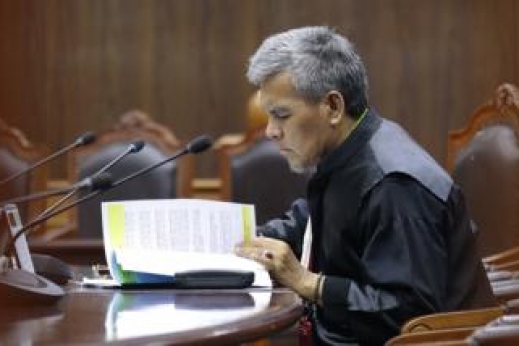
Youngky Fernando as legal counsel delivering the principal points of petition revision for judicial review of the Religious Court Law, Wednesday (20/12) in the Courtroom of the Constitutional Court. Photo by Humas MK/Ifa.
The Constitutional Court (MK) held a preliminary hearing of the judicial review of the Elucidation to Article 2 number 1 of Law No. 3/2006 on Religious Courts, Wednesday (20/12). The Case No. 99/PUU-XV/2017 was filed by a housewife from Sukabumi, Nina Handayani, in relation to the legal status of transnational marriage.
The Elucidation to Article 2 number 1 of the Religious Court Law reads:
"’People seeking justice" are any Indonesian citizens or foreign nationals seeking justice within the courts of Indonesia."
The Petitioner\'s attorney Youngky Fernando said that the Petitioner married a Malaysian man named Mohd Zuki bin Daud on April 2, 2006. Then on March 22, 2017, the husband filed a divorce. During the marriage, the Petitioner is still an Indonesian citizen. A problem arose when the Petitioner\'s marriage ended in the divorce and it was found out that the transnational marriage of the Petitioner was not legal in the eye of international civil law, resulting in the marital status of the Petitioner being a kind of common-law marriage (unregistered in the Religious Affairs Office/KUA). The Petitioner was then in dispute with her ex-husband regarding the ownership of property acquired during the marriage. Then the Petitioner filed a suit in the Religious Court up to cassation level.
After the divorce, Youngki explained, there was a division of property in the form of land owned by the Petitioner, but was not agreed by the Petitioner. This is because the Petitioner\'s and her husband\'s marriage books were not legalized by the Ministry of Law and Human Rights (Kemenkumham), the Ministry of Foreign Affairs (Kemenlu), and were not registered in the Malaysian and Selangor State Embassy.
"This makes the transnational marital status invalid under the International Civil Law, Indonesian Law, or Malaysian Law. It is also in accordance with the opinion of Lii Rasjidi in the book Marriage and Divorce in Malaysia and Indonesia," Youngki said in the session chaired by Justice Saldi Isra.
In addition, in the case in the Religious Court, the Petitioner considers that the phrase "people seeking justice" in the Elucidation of Article 2 of the a quo law has multiple interpretations, which is used as a way for the judge of the Religious Court of Indonesia to play with the interpretation, ultimately giving way to corruptive behavior to obtain joint property of the Petitioner. The phrase "people seeking justice" in the a quo provision does not explain the notion of foreign national, who is instantly subject to the law in the General Courts, or in Special Courts, Religious Courts, State Administrative Courts, and Military Courts.
Therefore, the Petitioner requests that the Court declare the phrase "people seeking justice" contrary to the Constitution and having no binding legal force, as long as it is not interpreted as "a foreign national in a transnational marriage that is legal in the eye of international law and existing laws in both the spouses’ countries.”
Justices’ Advice
Responding to the request, Constitutional Justice Saldi Isra asked that the Petitioner pay attention to the legal standing that he deemed unclear. He requested that the legal standing be clarified so that the Court can understand the petition. "The legal standing should be made clearer. So, we the panel of justices are convinced that the Petitioner does have a legal reason to file this petition," he asserted.
Meanwhile, on the argument of the petition, Justice Saldi asked the Petitioner to not do sorting. He also asked the Petitioner to explain the reasons for constitutional impairment by the enactment of the elucidation to the article of the law. "The most important is explanation. Because if we cannot comprehend the harm and the norm is still valid, it will harm the Petitioner, then it is certainly difficult for the Court to grant this petition," he explained further.
Meanwhile, Justice Maria Farida Indrati observed that the posita and petitum had no correlation. The posita explains marriage and purchase of land, but in the petitum, the Petitioner requests an interpretation for the phrase "people seeking justice." "It is not relevant at all. So, what is requested in the review must be reformulated, "he said.
On the other hand, Justice Maria stressed that the Constitutional Court does not hear concrete cases, but concrete cases could be the basis for reviewing a norm in the law. (ARS/LA/Yuniar Widiastuti)
Wednesday, January 10, 2018 | 16:55 WIB 247