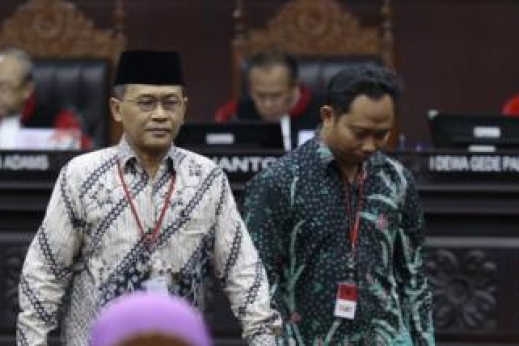
Ahmad Suaedy and Al Makin presented by the relevant party as experts in the judicial review hearing of the Blasphemy Law, on Wednesday (10/1) in the Courtroom of the Constitutional Court. Photo by Humas MK/Ifa.
Minority groups like Ahmadiyya are vulnerable to discrimination in public services. This was conveyed by Ombudsman official Ahmad Suaedy as a Relevant Party Expert in the judicial review hearing of Law No. 1/PNPS/1965 on the Prevention of Religious Abuse and/or Blasphemy (Blasphemy Law) filed by the Ahmadiyya Community. The tenth session of Case No. 56/PUU-XV/2017 was held by the Constitutional Court (MK) on Wednesday (10/1) in the Courtroom of the Constitutional Court.
Suaedy, presented by the National Commission on Violence Against Women (Komnas Perempuan), explained that discrimination occurred due to multiple interpretations of a law. The absence of clear and specific restrictions of the definition of the law was revealed by Suaedy as the trigger of the multiple interpretations. According to Suaedy, equality in public service is supposed to be based on the mandate of the 1945 Constitution. "Public service in an independent, sovereign, and democratic country like Indonesia cannot be excluded only because the minorities are different from the majority," he said before the Panel of Justices led by Chief Justice of the Constitutional Court Arief Hidayat.
Then Suaedy stressed the need for the Government to protect the weak and to restrict offensive parties to avoid violence. Moreover, he continued, the Government should provide services to all Indonesian people indiscriminately, as a constitutional mandate.
"In many cases, violence, closure of Ahmadiyya mosques, for example, was done not only by groups of people who disagreed with the Ahmadiyya, but by government officials, such as the municipal police unit (Satpol PP). Of course they are ordered by Government officials above them. Therefore, the Government needs a law of which interpretation cannot be extended, in order to protect the Ahmadiyya and other vulnerable groups," he explained.
The Petitioners claimed that their constitutional rights were violated by the enactment of Articles 1, 2, and 3 of the Blasphemy Law. According to them, the Joint Decree of the Minister of Religious Affairs, the Attorney General, and the Minister of Home Affairs of the Republic of Indonesia concerning Warning and Order to Adherents, Members and/or Leading Members of the Indonesian Ahmadiyya Jama\'at (JAI) and Members of the General Public (Joint Decree of 3 Ministers) drafted based on the three articles had caused them damages. The Joint Decree of 3 Ministers established Ahmadiyya as a cult.
The Petitioners were directly affected and their right to religion and to worship were restricted and suppressed because of the joint decree. There was a domino effect in the lives of Ahmadiyya adherents, for example the Petitioners can no longer worship in the mosques they built because they were burned or sealed, they cannot record their marriage in Religious Affairs Office (KUA), and they were even evicted from their residences. Therefore, the Petitioners requested that Articles 1, 2, and 3 of the Blasphemy Law be declared contrary to the 1945 Constitution with constitutional conditions, in particular Article 28C paragraph (2), Article 28D paragraph (1), Article 28E paragraphs 1) and (2), Article 28I paragraph (2), Article 28G paragraph (1), and Article 29 paragraph (2) of the 1945 Constitution and having no binding legal force as long as they are interpreted to be against the citizens of the Ahmadiyya community who only worship in their places of worship internally and not in public. (Lulu Anjarsari/Yuniar Widiastuti)
Wednesday, January 10, 2018 | 17:07 WIB 271