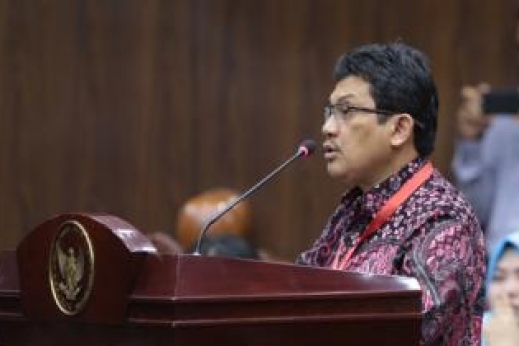
Government\\'s statement being conveyed by the Director General of Science & Technology Resource and Higher Education of the Ministry of Research, Technology, and Higher Education Ali Gufron Mukti at the judicial review of the Teacher and Lecturer Law on Tuesday (5/12) in the Courtroom of the Constitutional Court. Photo by Humas MK/Ganie.
The requirements to occupy a professorship academic position are not a matter of constitutionality of the norms of law, but rather an open policy of legislators. There is no question of discrimination in the requirements and it is not limited to research professors only, but also includes professors of education and community service insofar as they meet the requirements and qualifications prescribed by law. Such is the Government statement conveyed by the Director General of Science & Technology Resource and Higher Education of the Ministry of Research, Technology, and Higher Education Ali Gufron Mukti in the follow-up session of the judicial review of Law No. 14/2005 on Teachers and Lecturers on Tuesday (5/12) afternoon.
The government is of the opinion that there is a requirement of doctoral education for prospective professors because professorship is an academic position in formal education. In addition, Ali continued, professors serve to practice the tridharma (three pillars) of university—teaching, research, community service—that requires doctoral academic qualification, which is a formal education title for educators who will occupy a professorship.
"One of the duties of academic professorship is teaching and guiding doctoral program students. So it is very logical that professors should have a doctorate. How can a person who has no doctorate degree and never received a doctoral education teach and guide doctoral students?"Ali said.
In addition, the Government views that the Teacher and Lecturer Law guarantees basic rights and provide protection to the citizens. Ali also explained that the a quo law is the Government\\'s effort in organizing a national education system, advancing science and technology, and ensuring the implementation of state duties as required by a state of law. Then, Ali asserted that the a quo law is in accordance with Article 31 paragraphs (3) and (5) and Article 32 paragraph (1) of the 1945 Constitution.
The enactment of the a quo law, according to the Government, is not a form of discrimination and injustice. It is based on the principle of justice "same treatment is given to the same condition.” The academic professorship has special and distinct conditions, especially in relation to its function in the tridharma of university, which is different from academic positions below professorship.
Responding to the Petitioner’s petition concerning the provision of Article 48 paragraph (3) of the Teacher and Lecturer Law, the Government considers the petition contradictory to the 1945 Constitution and having no binding legal force as long as it is interpreted as the decree of the Constitutional Court is blurred.
"In his petition, the Petitioner describes his concrete legal problem regarding the norms petitioned for review. The Government did not find sufficient explanation on the issue of constitutionality. According to the Government, confusion between posita, which contains a description of a concrete case, and a petitum, which contains the statement of unconstitutionality of the norm of law against the 1945 Constitution, has resulted in the blurriness of the Petitioner\\'s petition," Ali said.
The Petitioner of the Case No. 87/PUU-XV/2017 is Suharto, a lecturer at the Faculty of Engineering of Brawijaya University, Malang; he reviews Article 48 paragraph (3) of the Teacher and Lecturer Law that reads, “The requirement to occupy an academic professorship is the academic qualification of a doctorate." The Petitioner, who has worked as a lecturer for almost 30 years, has been harmed by the a quo norm because he cannot be promoted. (Nano Tresna Arfana/LA/Yuniar Widiastuti)
Tuesday, December 05, 2017 | 17:46 WIB 288