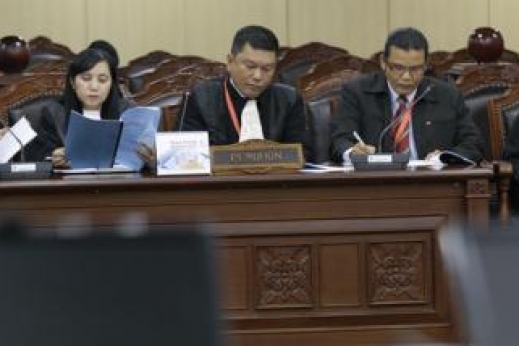
The Petitioner’s attorneys attending the preliminary hearing of the judicial review of Article 25 of Law No.18/2003 on Advocates, held on Thursday (16/11) in the Courtroom of the Constitutional Court. Photo by Humas MK/Ifa.
The provision of use of toga for advocates is tested materially in the Constitutional Court. The first hearing of the judicial review of Article 25 of Law No. 18/2003 on Advocates (Advocates Law) held by the Constitutional Court (MK) on Thursday (16/11). Batara Paruhum Radjagukguk is registered as Petitioner of Case No. 89/PUU-XV/2017.
In his petition, the Petitioner reviews the material of Article 25 of the Advocate Law that was deemed discriminatory. Article 25 of the Advocates Law reads "Advocates who carries out duties in court in handling criminal cases shall put on attributes in accordance with the laws and regulations."
The Petiitoner requested that the use of toga be mandatory for advocates in all cases in court because so far the obligation to wear a toga only applies in trials of criminal cases. Victor P. Sinaga as attorney explained that the a quo article raises legal uncertainty and different treatments. According to the Petitioner, the toga is the characteristic of lawyers as law enforcers. "If this condition is allowed, it will diminish the image and identity of lawyers as law enforcers," he explained in a session led by Constitutional Justice Wahiduddin Adams.
This inconsistency, continued Victor, led to legal uncertainty for the Petitioner in practice his profession. In addition, the Petitioner feels that his constitutional right to get equal treatment is violated. Victor also made a comparison of the mandatory use of the toga for judges. This should be applied to advocates as well. "With regard to the fact, the Petitioner filed the a quo petition to achieve uniformity in the use of the toga for advocates in all courts unless otherwise provided by law," he stressed.
On the arguments, the Petitioner requests that the Constitutional Court declare the a quo provision contrary to the 1945 Constitution and having no binding legal force.
Justices’ Advice
In response to the Petitioner\\'s petition, Constitution Justice I Dewa Gede Palguna viewed that the impairment of the Petitioner\\'s constitutional right was still unclear. He requested that the Petitioner strengthen the argument why the a quo article is against the 1945 Constitution. "So what is the causality? What norms are violated by the a quo Article? Do not directly jump into declaring the a quo article contradictory to the 1945 Constitution without any argument," he said.
He suggested that the Petitioner describe the reasons where the toga rule only applies for criminal cases to be argued. "In addition, the Petitioner’s request to amend the contents of the a quo article is incorrect, because the Constitutional Court does not have the authority to make laws," he said.
Meanwhile, Constitutional Justice Aswanto asserted that the Constitutional Court only deals with the constitutionality of a law. He had read that the petition has not clearly elaborated the issue of constitutional impairment. "The Petitioner\\'s view related to the a quo article is limited to implementation. The reason for the toga to be worn in all courts for being dashing or more dignified. This is not an argument about constitutional impairment," he asserted. (ARS/LA/Yuniar Widiastuti)
Thursday, November 16, 2017 | 15:59 WIB 667