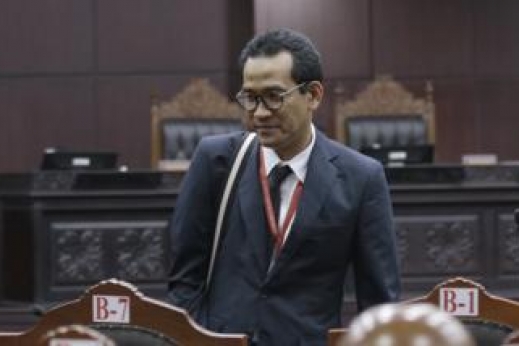
Refly Harun as attorney of the Petitioner after the judicial review hearing of the Regional Taxes and Levies Law, on Monday (30/10) in the Courtroom of the Constitutional Court. Photo by Humas MK/Ifa.
Mahkamah Konstitusi (MK) kembali menggelar sidang kedua uji materiil Undang-Undang Nomor 28 Tahun 2009 tentang Pajak Daerah dan Retribusi Daerah (UU PDRD), Senin (30/10). Asosiasi Pengusaha Indonesia (APINDO) selaku Pemohon Perkara Nomor 80/PUU-XV/2017 tersebut menguji Pasal 1 angka 28, Pasal 52 ayat (1), Pasal 52 ayat (2), Pasal 55 ayat (2), dan Pasal 55 ayat (3) UU PDRD.
The Constitutional Court (MK) once held the second hearing of the judicial review of Law No. 28/2009 on Regional Taxes and Levies (PDRD Law), Monday (30/10). The Employers\' Association of Indonesia (Apindo) as Petitioner of Case No. 80/PUU-XV/2017 reviews Article 1 point 28, Article 52 paragraph (1), Article 52 paragraph (2), Article 55 paragraph (2), and Article 55 paragraph (3) of the PDRD Law.
Dalam perbaikan permohonannya, Pemohon melalui Refly Harun menyampaikan legal standing Pemohon bahwa Apindo adalah organisasi yang memiliki 410 anggota luar biasa dan anggota biasa yang tersebar. Selain itu, Pemohon juga memberikan contoh-contoh mengenai ketetapan pajak yang dikeluarkan pemerintah yang berbeda dengan perhitungan perusahaan sesuai saran Panel Hakim pada sidang sebelumnya. Di samping itu, terkait dalil permohonan, Pemohon menyampaikan perbaikan Petitum dengan mengajukan permintaan kewajiban membayar pajak penerangan jalan tidak dikenakan terhadap listrik yang dihasilkan sendiri. Akan tetapi, lanjut Refly, terhadap listrik yang didapat dari negara melalui PLN, Pemohon menyatakan kesedian untuk membayar, baik untuk kegiatan produksi maupun nonproduksi.
In the petition revision, the Petitioner through attorney Refly Harun submitted its legal standing, that Apindo is an organization with 410 outstanding members and ordinary members. In addition, the Petitioners also provide examples of tax provisions issued by the government that are different from the company\'s calculations, in accordance with the Panel\'s suggestion in the previous hearing. In addition, with regard to the arguments of the petition, the Petitioner submits the petitum revision by submitting a request that the mandatory street lighting tax not be imposed on self-generated electricity. However, continued Refly, on electricity obtained from the state through PLN, the Petitioner states its willingness to pay, both for use in production and non-production activities.
“Jadi, Pemohon bersedia membayar pajak terhadap listrik yang diperoleh dari negara, sedangkan yang dihasilkan sendiri, Pemohon menganggap seharusnya itu tidak dikenakan pajak. Dan di sinilah Pemohon merasa ada ketidakadilan dengan batu uji Pasal 28D UUD 1945,” tegas Refly di hadapan pimpinan sidang Hakim Konstitusi Saldi Isra yang juga didampingi Hakim Konstitusi Maria Farida Indrati dan Aswanto.
"So, the Petitioner is willing to pay taxes on electricity obtained from the state, while the Petitioner considers self-generated electricity should not be taxed. In this case does the Petitioner feel injustice with Article 28D of the 1945 Constitution as point of reference," said Refly before chairman Constitutional Justice Saldi Isra in the presence of Constitutional Justices Maria Farida Indrati and Aswanto.
Dalam permohonan sebelumnya, Pemohon menilai dengan berlakunya UU a quo telah menimbulkan ketidakpastian hukum dan menyebabkan Pemohon tidak mendapat perlindungan yang adil sesuai dengan Pasal 28D ayat (1) UUD 1945. Pemohon menilai, seharusnya dalam menjalankan usahanya, Pemohon tidak dikenakan pajak penerangan jalan. Jika harus dikenakan pajak, hanya terbatas pada tenaga listrik yang bersumber dari negara dan digunakan untuk kegiatan nonproduksi. (Sri Pujianti/LA)
In the previous petition, the Petitioner considered that the enactment of the a quo law had caused legal uncertainty and keep the Petitioner from getting a fair protection in accordance with Article 28D Paragraph (1) of the 1945 Constitution. The Petitioner claims that, in the case of its business, it should not be levied on street lighting tax. If it is, the tax should be limited to electricity originating from the state and used for non-production activities. (Sri Pujianti/LA)
Monday, October 30, 2017 | 18:01 WIB 200