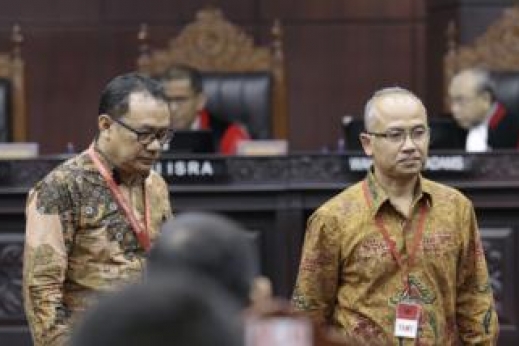
Asep Warlan Yusuf and Atip Latipulhayat (left to right) presented by the Petitioners to give their testimonies in judicial review hearing of the Government Regulation in Lieu of Law on Mass Organization (Ormas Perppu) on Thursday (26/10) in the Courtroom of the Constitutional Court. Photo by Humas MK/Ifa.
Mass organizations (ormas) should be fostered and developed in order to assist, support, and strengthen government programs. This was conveyed by Lecturer of Constitutional Law of Parahyangan Catholic University Bandung Asep Warlan Yusuf in a material review hearing of the Government Regulation in Lieu of Law No. 2/2017 on the Amendment of Law Number 17 Year 2013 on Community Organization (Perppu Ormas), Thursday (26/10) in the Courtroom of the Constitutional Court. The hearing was held for eight petitions, i.e. Cases No. 38/PUU-XV/2017, 39/PUU-XV/2017, 41/PUU-XV/2017, 48/PUU-XV/2017, 49/PUU-XV/2017, 50/PUU-XV/2017, 52/PUU-XV/2017, and 58/PUU-XV/2017. The hearing was scheduled to hear information from an Expert in Case 49/PUU-XV/2017 petitioned by Jeje Jaenudin (Central Committee of Persatuan Islam).
Asep described the essence of the birth of the law that regulates mass organizations in a state of law. In his explanation, Asep said that the meaning of Ormas Law must be associated with the system of state of law and the framework of democratic system contained in the fourth principle of Pancasila. In the study of constitutional law, Asep continued, the birth of a mass organization must be to advance government programs.
"It [should be] ensured that mass organizations are fostered, developed in order to help, support, and strengthen government programs. Therefore, this way of thinking shows that mass organizations must be observed based on the approach or study of constitutional law, not of state administration law," he explained in the session led by Chief Justice of the Constitutional Court Arief Hidayat.
In addition, Asep claimed Ormas Perppu shifted the perception on the function of mass organizations in constitutional law, thereby setting democracy back. Given the current issues, he also observed that there has been a shift of mass organizations, which should exist in the domain of constitutional law, into the domain of state administration law. "Why is that? Because in state administration law, the state does not involve other state institutions to conduct an in-depth study of the need to issue a policy including by dissolving a mass organization," he explained.
Asep also mentioned that mass organization is one of the ways to establish a state, meaning that the state cannot stand alone. There are several components that make it a whole state, namely political parties, suppressive organizations, and the media. "So, if observed from the constitutional law, then the existence of a mass organization or organ suppressor is legitimate," said Asep in the hearing led by Chief Justice of the Constitutional Court Arief Hidayat.
Violating Human Rights
Next, Lecturer of Law of Padjadjaran University Atip Latipulhayat gave his statement in the perspective of human rights contained in the Ormas Perppu. In his statement, Atip mentioned that the the Ormas Perppu should not restrict human rights, including freedom of association and assembly. Furthermore, when referring to human rights, they are also associated with the dissolution of institutions. Therefore, freedom of association and assembly organized by mass organizations, which is a place to realize rights, then become an important component in the life of the community, in social, economic, religious, political, and other aspects. Freedom of association and assembly are also clearly protected by the 1945 Constitution, as well as Law No. 17/2013 on mass organizations. However, Atip also reminded that freedom is not absolute; there are restrictions, which are given a clear and definite guarantee. According to Atip, there are two standard formulas of freedom, first: freedom is a rule, and second: restrictions are exceptions. "It means that it is important to look at two things about restriction, in that restriction should not diminish the essence of rights, and the relationship between rights and exceptions should not be confused or exchanged," said Atip.
Philosophically, legitimate restriction on freedom of association and assembly should be proportionate and justified by law. To ensure this, it is done through the court. Atip also added that if the perppu dissolved a mass organization without any court process, it would be negating the law.
“So, once more, I’d like to stress that the due process of law is not court process, but one that is reasonable, just, and proper. A perrpu that negates court process not only insults the law, but also negates it,” said Atip.
On the same occasion, in connection with the legalization of the Ormas Perrpu by the House of Representatives as a law, Petitioner No. 50/PUU-XV/2017, including the Dewan Dakwah Islamiyah Indonesia, Yayasan Forum Silaturahmi Antar Pengajian Indonesia, and the Indonesian Islamic Student Association, withdrew their petition. At the end of the hearing , Chief Justice of the Constitutional Court Arief Hidayat stated that in relation to the passing of the Ormas Perppu into law by the House of Representatives, further hearing will be held after the Judges\' Deliberation Meeting (RPH) so the Petitioners are expected to wait for the invitation from the clerk. (Sri Pujianti/LA/Yuniar Widiastuti)
Friday, October 27, 2017 | 10:09 WIB 291