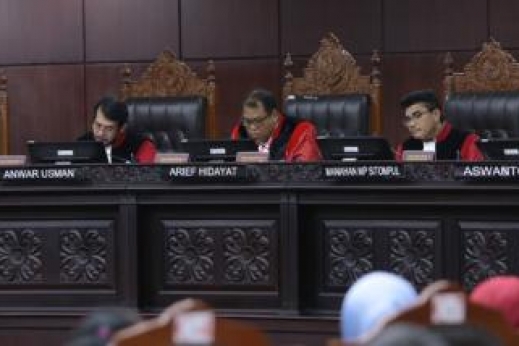
Court hearing of the verdict of judicial review of Child Protection Law, Thursday (19/10) in the Plenary Hall of the Constitutional Court Building. Photo by Humas MK/Ganie.
The Constitutional Court (MK) rejected the material judicial review of the regulation on child exploitation prohibition as stipulated in Article 76I of Law No. 35 of 2014 on Child Protection, Thursday (19/10). The case No. 33/PUU-XV/2017 was judged unreasonable by law.
"Rejected the Petitioner\'s petition completely," said Chief Justice of the Constitutional Court, Arief Hidayat, reading out the verdict in the presence of the eight other constitutional judges.
Tajudin bin Tatang Rusmana as Petitioner is a cobek maker from Jaya Mekar Village, Padalarang Sub-district, West Bandung Regency. He was sentenced to nine months in prison on charges of employing minors. Tajudin was then arrested by South Tangerang police resort on April 20, 2016 and released on January 14, 2017 after being acquitted. The Petitioner was of the opinion that the provisions of Article 76I of the Child Protection Law were important as a form of protection for the citizens. On the other hand, the Petitioner stated that the phrase "economic exploitation" should be interpreted more clearly.
In his petition, the Petitioner argued that Article 76I of the Child Protection Law was contradictory to Article 27 paragraph (2) of the 1945 Constitution. With regard to the Petitioners\' argument, the Court, represented by Constitutional Court Justice I Dewa Gede Palguna, believes that Article 76I of the Child Protection Law has no correlation or relevance to Article 27 paragraph (2) of the 1945 Constitution because Article 76I of the Child Protection Law does not inhibit or impede or limit the right to work and decent livelihood. If the Petitioner considered Article 76I of the Child Protection Law contradictory to Article 27 paragraph (2) of the 1945 Constitution, it meant that the Petitioner considered that exploiting children economically was a part of the right to work and decent livelihood for humanity. "In this case, the Petitioner\'s reasoning is absurd. Therefore, the Petitioners\' argument is unreasonable according to law," Justice Palguna said.
In addition, Justice Palguna stated that the logic and argument of the petition was exactly the same as those of case No. 32/PUU-XV/2017. Case No. 32/PUU-XV/2017, he added, was filed simultaneously with case No. 33/PUU-XV/2017 by the Petitioner. The logic and arguments proposed in both a quo petitions is almost identical, except on the provisions of the law being reviewed. As with petition No. 32/PUU-XV/2017, the Petitioner confused the logic and arguments of a concrete case faced by the Petitioner with the issue of the constitutionality of the law, in casu the Child Protection Law. In relation to this, the Court needs to re-affirm that the issue of constitutionality of a norm of law must be distinguished with the application of a norm of law.
Justice Palguna continued, in the case of the Petitioner, it was not the issue of the constitutionality of the law, in casu Article 76I of the Child Protection Law, but the issue of the application of the law, which in this case is closely related to evidence. In a concrete case if a person is convicted of a violation of Article 76I of the Child Protection Law, it does not mean that Article 76I of the Child Protection Law is contradictory to the 1945 Constitution. Rather, according to the judge’s judgment, in such a case the person concerned is proven to have committed a crime as prosecuted by the public prosecutor.
"Such judge’s judgments cannot be interfered with by the [Constitutional] Court. If the person concerned feels not guilty, the criminal justice system provides legal measures for it, whether through ordinary legal measures, which are appeal and cassation, or extraordinary legal measures. It is entirely the jurisdiction of the Supreme Court and its subordinate courts within the public court of justice," Justice Palguna said. (ARS/LA/Yuniar Widiastuti)
Thursday, October 19, 2017 | 17:38 WIB 242