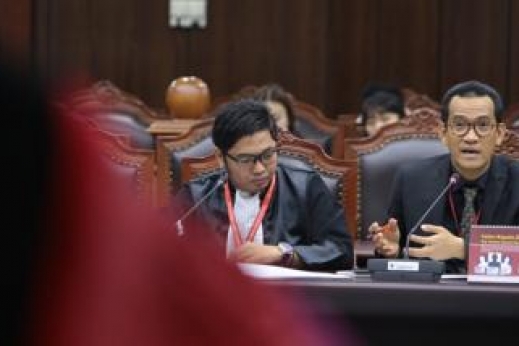
Petitioner\'s attorney Refly Harun delivering the petition principal for judicial review of the Regional Taxes and Levies Law (PDRD Law), Tuesday (17/10) in the Courtroom of the Constitutional Court. Photo by Humas MK/Ganie.
The Constitutional Court (MK) held a preliminary hearing on the judicial review of Law No. 28/2009 on Regional Taxes and Levies (PDRD Law) on Tuesday (17/10) afternoon. The Employers\' Association of Indonesia (Apindo) as Petitioner of Case No. 80/PUU-XV/2017, reviews Article 1 point 28, Article 52 paragraph (1), Article 52 paragraph (2), Article 55 paragraph (2), and Article 55 paragraph (3) of the PDRD Law.
The Petitioner’s attorney Refly Harun submitted the petition related to the interests of entrepreneurs or companies related to street lighting tax, which is claimed to be unfair and contradictory to the 1945 Constitution. The reason is that companies that use generators or independent power plants for production activities are still subject to street lighting tax. The Petitioner assessed that street lighting tax should be limited to the use of electricity originating from the state and used for non-production activities. The imposition of such a tax also hampered the company\'s production performance due to increased tax burden or liabilities.
The enactment of the a quo law has caused legal uncertainty and keep the Petitioner from getting a fair protection in accordance with Article 28D Paragraph (1) of the 1945 Constitution. The Petitioner claimed that, in the case of his business, he should not be levied on street lighting tax. If he is, it should be limited to electricity originating from the state and used for non-production activities.
"Because if we observe the definition of street lighting tax, it is closely related to street lighting. As stipulated in the elucidation of Article 2 paragraph (2) letter d of Law No. 18/1997, which has just been replaced by the new law, street lighting tax is a tax on the use of electricity with the provision that in the area, street lighting is available, which is paid by the local government," Refly told Constitutional Justice Saldi Isra as chairman of the hearing.
The next objection of the Petitioner, continued Refly, is concerned with Article 52 paragraph (1) of the PDRD Law, which reads, "The object of street lighting tax shall be the use of electricity, either self-generated or acquired from other sources."
"We also question the injustice that when the Petitioner supplies its own electricity, street lighting tax is still imposed. Though we know that should those who generate their own electricity, because PLN—in this case the country—has not provided enough supply [of electricity], should be appreciated. However, in this case street lighting tax is imposed on them, and it is not clarified whether in the area there is street lighting or not. So if [someone] uses electricity, either from other sources or self-generated, street lighting tax is imposed [on them]," said Refly.
Therefore, in the petitum, the Petitioner requests that the Constitutional Court declare the a quo law contradictory to the 1945 Constitution and having no binding legal force because it does not provide a fair guarantee of legal certainty. At a minimum, it should be declared conditionally contradictory to the constitution insofar it is not interpreted as street lighting tax is only imposed on electricity generated by the state and used for non-production purposes.
Justices’ Advice
Responding to the arguments of the Petitioner, Constitutional Justice Saldi Isra observed the Petitioner\'s constitutional harm. Justice Saldi also suggested that the Petitioner describe its constitutional harm. "A number that can be referred to. How much is it? One of the represented companies that joined APINDO could make and describe a table, [that] he has his own generator. Then because of the enactment of the article in question, he must pay taxes for what is in question. How much? So that it can be an additional argument for the Petitioner," Justice Saldi explained.
Meanwhile, Constitutional Justice Maria Farida Indrati questioned the legal standing of the Petitioner. "I’ll just add to the legal standing. So, this Petitioner is an association, not an individual? Please add the constitutional harm suffered by the Petitioner. We have seen the financial impact," said Justice Maria.
Next, Justice Maria highlighted the evidence of the Petitioner. In the list of evidence, it is stated that Exhibit P-3 it is Law No. 28/2009 on Regional Taxes and Levies. "But the physical evidence is a copy of the Deed of Declaration of the Decision of the National Special Deliberation of the association; please fix it later with the Clerk," Justice Maria advised. (Nano Tresna Arfana/LA/Yuniar Widiastuti)
Wednesday, October 18, 2017 | 08:44 WIB 172