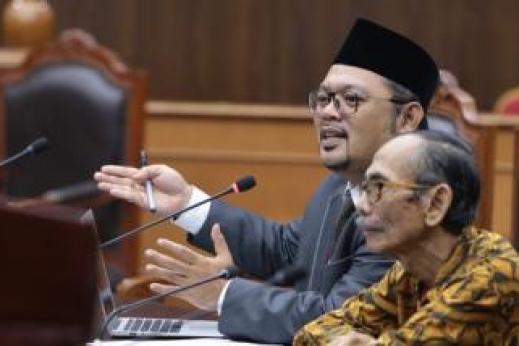
The Expert presented by the Government, Lecturer of the Faculty of Economics and Business of UIN Syarif Hidayatullah Arief Mufraini and State Finance and Taxation Expert Siswo Sujanto each deliver their expertise in the judicial review hearing of Law on Hajj Funds Management on Wednesday 18/10) in the Courtroom of the Constitutional Court. Photo by Humas MK/Ganie.
The Constitutional Court (MK) once again held a judicial review hearing of Law Law No. 34/2014 on Hajj Funds Management, Wednesday (18/10). The fifth session of Case No. 51/PUU-XV/2017 filed by Muhammad Sholeh was held in the Courtroom of the Constitutional Court with the agenda to hear the statements of the House of Representatives (DPR) and Experts from the Government. However, DPR once again was unable to attend.
In the hearing, Lecturer of the Faculty of Economics and Business of UIN Syarif Hidayatullah, Arief Mufraini, as the Government’s Expert explained that the Hajj Funds Management Law serves to avoiding slowness and failure in the management of hajj funds. According to him, in the perspective of modern economy and finance on a macro scale, the community activity to pay for hajj fund can be interpreted as accumulated savings to anticipate future income uncertainty. This is also associated with economic growth. Thus, economic rationality presents an intermediary institution, namely the Hajj Fund Management Agency (BPKH) and the banks that manage hajj funds. Both institutions provide rationality in asset storage in more favorable conditions. However, the knowledge of Islam corrects it, that it is a form of direct payment for the benefit of utility sharing among pilgrim candidates in improving hajj services.
"Based on this, the spirit of the a quo law is present as self-reinforcement of the Islamic community in the framework of avoiding inertia and coordination failure. Thus, the amount of the initial deposit is closely related to the government\'s policy, in which the provisions are relative and this law only regulates the initial deposit and does not state the entire amount because the agreement and fair price can be regulated by its derivative regulations," Arief explained.
Furthermore, Arief also explained in the classical fiqih perspective, the accumulation of hajj funds lied in the management and development in the period prior to the a quo law, such as syirkah amlaak. It implies the ownership of an object together without a preceding contract. The form is a common ownership arising from mutual acts of all parties that have the right of ownership. In this case, hajj candidates paid to the Government-managed Hajj Management Body (BPIH) for the improvement of services for all pilgrims.
"Based on these conditions, to maintain the rights and obligations to be more syar\'i (adhering to religious rules), the Government presented the a quo law by making BPIH as the representative of pilgrims on the ownership and management of hajj funds," Arief explained before Chief Justice of the Constitutional Court Arief Hidayat, in the presence of the other eight Constitutional Court Justices.
Arief continued that BPKH can represent the pilgrims in the ownership and management of hajj funds. This means that the hajj funds institution has the legal form for different rights, obligations, and dependents of the owners of the institution, i.e. the hajj pilgrims. So, he continued, BPKH can perform the management and development of hajj funds without having to first ask permission to prospective hajj pilgrims.
Feasibility Test Instrument
Meanwhile, the State Finance and Taxation Expert Siswo Sujanto believes that in state finance law, the state must constitutionally meet the needs of its people in the form of public services. In principle, public services are a basic requirement that the government must provide.
"Given that it is a basic need, that means the government provides [it] for free. [This is] because of the improving concept of public services, including the needs of hajj pilgrimage. And this is one of the needs guaranteed by the state," explained Siswo, who is an initiator and member of the drafting team of the State Finance Law.
Siswo also added that historically, Government involvement in the management and implementation of hajj funds has long been taking place, even since the colonial period. In its development, hajj management problems include not only the possibility of a person to depart [for a hajj pilgrimage], but also the quota provided by the government of Saudi Arabia. "So, the Government must perform a selection and is authorized to conduct it," he said.
In relation to the increasing number of hajj applicants and the limited quota approved by the Saudi government, the partial payment obligation during registration is one of the selection instruments that can control it. "This means, someone who has deposited will be categorized as capable. This ability [to pay] is not measured in the future years, but at the time of registration. This pattern is considered fair enough considering to the operational cost of hajj," he explained.
At the end of the hearing, Chief Justice of the Constitutional Court Arief Hidayat requested that the Petitioner and the Government submit the conclusion to the Court Registrar no later than Thursday, October 26, 2017 at 14.00 p.m.
In the principal issue of his petition, Sholeh argues that his constitutional rights are violated by the enactment of three articles, namely Article 24 letter a, Article 46 paragraph (2), and Article 48 paragraph (2) of the Hajj Funds Management Law. The Petitioner registered as a pilgrim candidate at the Office of Ministry of Religious Affairs in Sidoarjo, East Java, by depositing Rp20 million funds on February 13, 2008. However, the Petitioner never received explanation whether the deposited fund would be invested. According to the Petitioner, it would violate his constitutional rights if his hajj funds were used for investment without approval. Therefore, the Petitioner requested that the Panel of Justices revoke the three articles. (Sri Pujianti/LA/Yuniar Widiastuti)
Wednesday, October 18, 2017 | 18:21 WIB 183