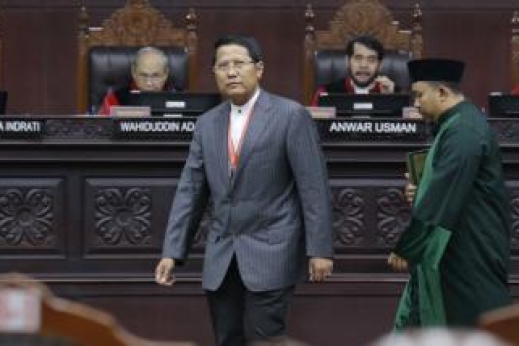
Sharia law expert Muhammad Cholil Nafis presented the Petitioner to give his testimony in the judicial review of the Law on Hajj Funds Management on Monday (9/10) in the Plenary Hall of the Constitutional Court. Photo by PR/Ifa.
On the provisions of hajj investment funds, the Government should improve the contract with prospective pilgrims. If the contract is not improved, the law will be haram (forbidden). This was conveyed by sharia law expertMuhammad Cholil Nafis in a judicial review of Law No. 34/2014 on Hajj Funds Management. The fourth hearing of the petition filed by Muhammad Sholeh was held at the Plenary Hall of the Constitutional Court on Monday (9/10). This hearing was scheduled to hear the testimonies of the House of Representatives (DPR) and Expert from the Petitioner of Case No. 51/PUU-XV/2017. Meanwhile, the House was unable to attend the hearing.
Cholil explained that the hajj pilgrimage funds will be invested in banking products. He said that the money deposited by hajj pilgrim candidates should be managed according to its contract. However, in reality, the deposit is invested by the Government on banking products with the principle of prudence and in accordance with sharia principles. He considers that the root of the hajj pilgrimage funds problem has actually been mitigated by the Hajj Funds Management Law, but the Government needs to adjust the agreement.
According to him, the Hajj Fund Management Agency (BPKH)should improve the contract with prospective pilgrims to state that the initial deposits of the hajj pilgrimage funds will be invested with mudharabah or wakalah bilujrah or other contracts in accordance with sharia law. This needs to be done considering that the initial deposits belong to the pilgrims, both departing in the current year or who are in the waiting list. Thus, the benefits or return on the investment should be returned to the pilgrims in accordance with the portions and percentages.
"In essence, the funds belong to the pilgrims. The use of investment returns to subsidize pilgrims in the current year will be haram (forbidden) if the pilgrims who have not departed are not informed or have not consented. Likewise, in optimization returns there are funds belonging to pilgrims who have not departed. If the Government wants to use the funds, they should ask for the prospective pilgrims’s consents. This can interfere with the acceptance (mabrur) of someone’s hajj," said Cholil before Deputy Chief Justice Anwar Usman and other Constitutional Justices.
Furthermore, Cholil also gave information about the absence of pilgrim candidate representatives in BPKH as part of the pilgrims’ funds management monitoring. Cholil stated that in Islamic teachings there is no provision mentioning an obligatory hajj manager representative among the pilgrims. The requirements for the representative are trustworthiness and responsibility, allowing any element for the position. "So, the requirements to be a BPKH member are very clear the selection is done openly," explained Cholil.
On the same occasion, Cholil also explained the policy of unilateral cancellation that should not be done by pilgrims unless they pass away and cannot pass their hajj membership on to an heir. He explained that in Islam, the deceased have no obligation to perform hajj pilgrimage so that their heirs are not obliged to perform hajj on their behalf [as a substitute]. [Substitution] as meant by the Petitioner can only be done by a person who has performed hajj pilgrimage. "So cessation of hajj membership for deceased prospective pilgrims is according to sharia law and it can make it easier for others to perform hajj pilgrimage," Cholil said as he delivered his statement in the Constitutional Court, in a hearing also attended by Muhammad Sholeh.
At the end of the hearing, Deputy Chief Justice Anwar said that the hearing would resume on Wednesday, October 18, 2017 at 11:00 a.m. to hear Expert\'s statement from the Government.
In the principal issue of his petition, Sholeh argues that his constitutional rights are violated by the enactment of three articles, namely Article 24 letter a, Article 46 paragraph (2), and Article 48 paragraph (2) of the Hajj Funds Management Law. The Petitioner registered as a pilgrim candidate at the Office of Ministry of Religious Affairs in Sidoarjo, East Java, by depositing Rp20 million funds on February 13, 2008. However, the Petitioner never received explanation whether the deposited fund would be invested. According to the Petitioner, it would violate his constitutional rights if his hajj funds were used for investment without approval. Therefore, the Petitioner requested that the Panel of Justices revoke the three articles. (Sri Pujianti/LA/Yuniar Widiastuti)
Tuesday, October 10, 2017 | 12:01 WIB 267