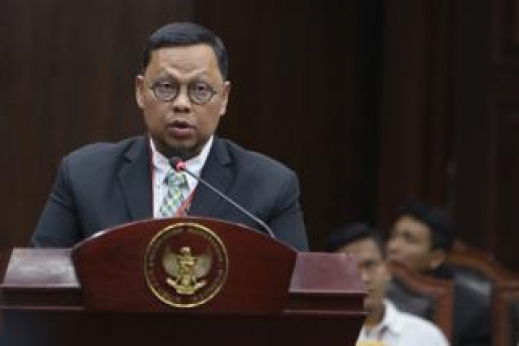
Chairman of the General Elections Bill Special Committee Lukman Edy who represented the House of Representatives delivering his statement related to the review of General Elections Law, Thursday (5/10) in the Plenary Hall of the Constitutional Court Building. Photo by PR/Ganie.
The threshold regulation in the nomination of president and vice president, or more commonly known as the presidential threshold, is considered by the House of Representatives (DPR) not to limit the citizens’ constitutional right to run for elections. This was stated by Chairman of the Special Committee on General Elections Bill Lukman Edy who represented the House of Representatives (DPR), in a statement related to the judicial review of Law No. 7/2017 on General Elections on Thursday (5/10). The fourth hearing of the six cases (Cases No. 44/PUU-XV/2017, 53/PUU-XV/2017, 59/PUU-XV/2017, 60/PUU-XV/2017, 61/PUU-XV/2017, and 62/PUU-XV/2017) was held by the Constitutional Court (MK) in the Plenary Hall of the Constitutional Court.
Lukman denied the assumption that Article 222 of the General Elections Law resulted in the obstruction of party leaders (in this case the Islam Damai Aman/Idaman Party) to run as presidential candidates. According to him, the Petitioners\' argument is merely assumptive because in essence, there is no limit to the nomination of presidential candidates as long as they qualify. The regulation of presidential and vice presidential candidates, according to the presidential threshold, is in fact intended so that the role of political parties as proposers of president and vice president candidates is carried out by members of the House of Representatives.
Lukma, who is a member of the PKB faction, also emphasized that the Petitioners need to observe the process of formulating the a quo law, which emphasized rights equality among political parties on two points: to equalize the requirements of election participants and to require the 2014 election participants meet new requirements. "Therefore, based on this, new and old members (political parties) are agreed to use the same conditions as the existing provisions in the rules of the previous elections," explained Lukman before the session led by Deputy Chief Justice Anwar Usman.
Furthermore, on the review of regulation regarding the privileges and rights of the Aceh Government, the House argued that what the Petitioners argued was mere assumptions. The Petitioners need to understand the creation of the Law on Aceh Government, which is actually a follow-up to the improvement of the implementation of the elections starting from the city level and the authority of the election organizers for the enforcement of law. "This reason is stipulated in the a quo article," Lukman explained.
Then Lukman said that the Law on Aceh Government was outdated while the law is always growing and not static. Therefore, in order to prevent dualism, the House and the Government as legislators formulated the a quo article. "The Aceh Government Law is a great consensus, but changes are made through this norm for legal adjustment and justice. Lawmakers, including those of a quo laws, always consider Aceh’s special status by keeping the Aceh Independent Commission (KIP) equivalent to regional level election commissions (KPU) as in other regions," Lukman explained.
Verification Beneficial
In addition, Lukman described Article 173 paragraph (1), paragraph (2) letter e, and paragraph (3) argued by the Petitioners of being discriminatory as a mere assumption because it does not prohibit political parties from performing their roles. "The House argues that the article actually provides an opportunity for political parties as election participants following the provisions of the law," explained Lukman before the Constitutional Court Deputy Chief Anwar Usman as chairman of the hearing.
As for the essence of justice questioned by the Petitioners concerning the provision of verification step for the political parties participating in the elections, Lukman explained that the implementation of the a quo article has an implication that political parties that have not undergone verification (new political parties) must pass verification by the Law and Human Rights Ministry and KPU. Meanwhile, political parties that have passed verification (old political parties) are obliged to input their latest data into the application of the Political Parties Information System (Sipol).
According to Lukman, an article [of the law] was created on benefits and rules on verification in the article being reviewed by the Petitioners and has many benefits. Political verification is considered capable of saving the state budget. "The a quo article contains benefits, considering that before the formation of General Elections Law, the House received funding details for verification alone that reaches nearly 600 billion. Therefore, it is necessary to save the state budget with the verification and clearly this article facilitates it," he explained.
No Harm in Doing Verification
Chairman of the Board of Regional Leaders of the Crescent Star Party of DKI Jakarta Province Madsani volunteered as a Relevant Party for Cases 53, 61, and 61/PUU-XV/2017. Madsani stated that the Petitioners who are the political parties participating in the elections must still go through the verification process. He stated that the provisions of the verification do not impair the Petitioners’ constitutional rights. "So, there is no real damage experienced by the Petitioners due to the a quo article. Therefore, the Relevant Party considers the a quo article being argued not to be contrary to the 1945 Constitution," he stressed.
According to the Relevant Party, elections are a form of the implementation of sovereignty, which are in the hands of the people and implemented honestly and fairly every five years. To that end, the Elections Law was established to ensure the implementation of elections with integrity. The purpose of verification is so that the people can see the quality of political parties, that through the verification, seasonal political parties that only appear during elections will be out. Regarding the verification process, Madsani added that new political parties must pass verification as a legal entity selected by the Law and Human Rights Ministry, and verification by KPU is not to impede, but it is a general requirement for all election participants. "The assurance of fair certainty is contained in the a quo article. So, this is not discrimination against new political parties," he said.
(Sri Pujianti/LA/Yuniar Widiastuti)
Thursday, October 05, 2017 | 17:55 WIB 152