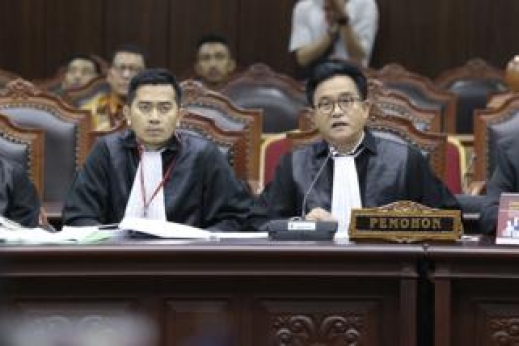
Yusril Ihza Mahendra as attorney delivering the petition principals for judicial review of Article 162 paragraphs (1) and (2) of Law No. 8/1981 on the Criminal Procedure Code (KUHAP) on Wednesday (4/10) at the Constitutional Court Building. Photo by PR/Ifa.
The Constitutional Court (MK) held the preliminary hearing of Article 162 paragraphs (1) and (2) of Law No. 8/1981 on the Criminal Procedure Code (KUHAP) on Wednesday (4/10). Emir Moesi, a former member of the House of Representatives for the 2004-2009 period, challenged the regulation on the testimony of witness who does not attend a court session.
Article 162 paragraphs (1) and (2) of KUHAP reads:
"Paragraph (1): If a witness after giving information during an investigation dies or because of a valid reason cannot attend the session or is not summoned because of the great distance to the place where he/she lives or domiciles or because of another reason connected with the interest of the state, the testimony he/she has given shall be read out.”
“Paragraph (2): If the information has earlier been given under oath, it shall be considered equal in value as a testimony given by a witness under oath during a court session.”
In his petition, Yusril Ihza Mahendra as legal counsel said that the article was contrary to the principle of legal certainty and justice as stipulated in Article 28D of the 1945 Constitution. "This provision violates the Petitioner\\'s constitutional right to obtain correct and fair criminal law enforcement," he explained in the hearing led by the Constitutional Justice Saldi Isra.
Article 162 paragraphs (1) and (2) of the Criminal Procedure Code stated that a witness may be absent from a hearing and may submit his/her testimony in writing. However, the testimony is considered equal in value as a testimony given at the hearing. According to Yusril, that provision has the potential of violating a defendant’s constitutional rights.
"It is vulnerable to abuse by the public prosecutor, because the testimony cannot be contradicted by other witnesses, cannot be confronted with other testimonies, cannot be questioned by the defendant. Even the judge cannot ask and see his/her expression when he/she gave his/her testimony," he read the Petition of Case No. 74/PUU-XV/2017.
Irrelevant
On the other hand, Yusril added that the article is no longer relevant. The Petitioner considered that with rapid advancement of technology, if a witness cannot come to the court for reasons in accordance with the article, visual communication can be carried out.
"Our question is whether such articles should be retained. With the advancement of technology, there are teleconferences, et cetera. We should be able to call witnesses and hear them through teleconference," he explained.
In the hearing, Yusril also recounted concrete cases that affected the Petitioner due to the enactment of the article. The Petitioner was the defendant in the alleged bribery case of Tarahan coal-fired power plant (PLTU), Lampung, in 2004. At that time, the Petitioner repeatedly asked the public prosecutor and the judges to present the President Director of Pacific Resources Pirooz Muhammad Sharafih who is a foreign national, but he was never called to court.
"He was investigated in the United States, not in the Indonesian Embassy. He did not come to the court, but his testimony was read in the police investigation report (BAP), received by the judges, and then Mr. Emir was convicted," Yusril said.
In fact, continued Yusril, not one of the testimonies of the witnesses who were present at court indicted the Petitioner. Then, after the fact, it was found out that the signature in the testimony was forged.
"So when [the testimony] was taken to the Criminal Investigation (Bareskrim), it was inspected and was found out to be fake, but when the forensic lab asked for the original, it was not available, and when summoned to court it was also not available. When it was summoned by the Corruption Eradication Commission (KPK), is was also unavailable," he explained.
On the case that indicted him, the Petitioner was sentenced to 3 years in prison and a fine of Rp150 million with a 3-month subsidiary jail sentence, although currently the Petitioner has served his sentence. However, the Petitioner requested that the Panel of Justices revoke the articles.
Justices’ Advice
In response to the request, Constitutional Justice Maria Farida Indrati, who was among the Panel of Justices, recommended a revision. Justice Maria stressed that the Constitutional Court cannot hear concrete cases. "It could be a concrete case, on the condition that it is limited to violation of a norm, and the Petitioner should make sure of this," she explained.
Constitutional Justice Manahan M. P. Sitompul requested that the Petitioner elaborate the article’s implementation in present context. Especially in relation to the video conference technology that could be an alternative for witnesses who cannot attend a court session. "It has been implemented in the Constitutional Court, but for general courts there is no regulation yet," he explained.
Justice Manahan reminded that if the Petitioner requested that the existing articles be revoked, there will be legal vacuum. In addition, he continued, conference should not be used in public courts because it does not provide an alternative interpretation of the a quo article. That is, it is interpreted that witnesses shall be present in the court without exception.
"So, try to elaborate on alternative interpretation in the petition. Do not the article’s revocation to have a major impact in the global world of law. The point of view should not be limited to the legal events that harm the Petitioner," he said. (ARS/LA/Yuniar Widiastuti)
Wednesday, October 04, 2017 | 18:41 WIB 217