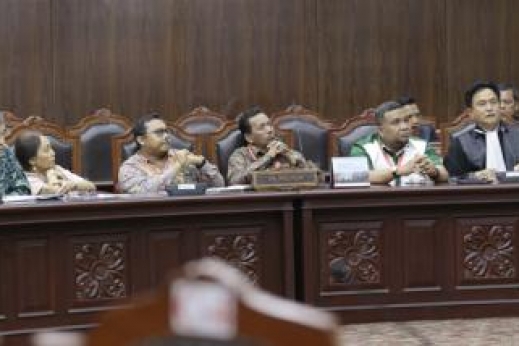
Regulation concerning presidential and vice presidential threshold contained in Law No. 7/2017 on General Elections is reviewed materially once again by the Constitutional Court (MK). The review is listed in four cases, namely 70, 71, 72, and 73/PUU-XV/2017. The Petitioners of these cases are the Crescent Star Party (Case No. 70/PUU-XV/2017); Hadar Nafis Gumay, Yuda Kusumaningsih, Titi Anggraini (Perludem), and Veri Junaidi (KODE) (Case No. 71/PUU-XV/2017); Mas Soeroso and Wahyu Naga Pratala (Case No. 72/PUU-XV/2017); as well as Partai Indonesia Kerja (PIKA) and the Indonesian Employers and Workers Party (Case No. 73/PUU-XV/2017).
The Petitioners feel that their constitutional rights have been violated by the enactment of Article 222 of the General Elections Law. Article 222 of the General Elections Law states:
"A Candidate Pair is nominated by a Political Party or a Coalition of Political Parties Contender of the Election who fulfills the seat requirement of at least 20% (twenty percent) of the total seats of the House of Representatives or who receive 25% (twenty- five percent) of the national valid votes in the previous election of members of the House of Representatives."
In its petition, the Crescent Star Party, represented by Yusril Ihza Mahendra as Chairman, claimed that the provisions governing the seats requirement of 20% of the House of Representatives’s (DPR) total seats or 25% of the national valid votes in previous parliamentary elections in the context of simultaneous general elections contradictory to the 1945 Constitution. The Petitioner considers the desire to limit the number of candidate President and Vice President pairs that may be proposed by a political party or coalition of political parties to only 5 (five) pairs with a 20% presidential threshold or only 4 (four) pairs with a 25% national valid votes an undemocratic decision. It is also considered contrary to the principle of people\'s sovereignty as stipulated in Article 1 paragraph (2) of the 1945 Constitution.
Yusril explained that the Constitutional Court had declared presidential threshold four times. He stated that even though his petition was fifth, his petition was different from the previous ones that were rejected by the Constitutional Court. "To the rejected petitioners, the Constitutional Court always stated that this was an open legal policy by the legislators," Yusril said before the Panel of Justices led by Constitutional Justice Aswanto.
However, Yusril continued, although the rule is an open political policy, the Constitutional Court cannot automatically cancel it. According to the Constitutional Court, the Constitutional Court cannot necessarily revoke a bad regulation because the norm of bad law is not automatically unconstitutional. For that reason, Yusril no longer uses the 1945 Constitution as point of reference.
"The Court will only cancel [a regulation] if it goes against rationality, morality, and constitutional justice. Is that meaningful? The Constitutional Court invited us to review it using legal philosophy, not with the 1945 Constitution because judicial review [of the law] using the 1945 Constitution was rejected four times. If we speak of rationality, morality, and injustice, we enter legal philosophy and our whole argument is the philosophy of law," he said.
Meanwhile, Hadar as Petitioner of Case No. 71/PUU-XV/2017 claimed the presidential threshold regulation contrary to rights equality for all election participants to run for president and vice president. In addition, he continued, Article 222 of the General Elections Law contradicts the decision of the Court No. 14/PUU-XI/2013 that the implementation of presidential elections should be prevented from political transactions of positions. According to him, with presidential threshold, [such transactions] have great potential to grow between political parties.
Mas Soeroso, Petitioner of Case No. 72/PUU-XV/2017, claimed that the presidential threshold regulation limit the political rights of Indonesian citizens. Potential and intelligent nation figures are kept from running for president because the power to nominate president is in the hands of political parties that must coalesce with each other to promote the president and vice president.
"As the leader of an NGO in Banyuwangi Regency, I always strive to educate people to choose wholesome leaders with integrity. The presidential threshold regulation will limit presidential and vice presidential candidates to certain people only. No alternative candidates will get the opportunity to emerge," he said.
In the same hearing, Partai Indonesia Kerja (PIKA) and the Indonesian Employers and Workers Party (P3I) as Petitioners of Case No. 73/PUU-XV/2017 reviewed Article 173 paragraph (2) letters b, c, d, e, f, and g as well as Article 173 paragraph (3) of the General Election Law related to the requirements of political parties as election participants. However, during the preliminary hearing, PIKA revoked its petition so that the Petitioner for Case No. 73/PUU-XV/2017 is only P3I. "The regulation kept us from participating in the elections. This is contrary to Article 28 of the 1945 Constitution, which protects freedom of association. It reflects injustice and is a form of discrimination," explained Heriyanto as the legal counsel.
Justices’ Advice
In response to the petitions, the Panel of Justices consisting of Constitutional Justices I Dewa Gede Palguna and Wahiduddin Adams provided some recommendations. For Case 71/PUU-XV/2017, Justice Palguna demanded a clearer claim of constitutional damages and that the petitum be summarized. The same was also recommended for Case 72/PUU-XV/2017. "I think the (constitutional damages) need to be clarified. Then, on legal entity, it is somewhat more lax for a legal entity because for a legal entity, it is enough if the activity is related to the issues being reviewed in the law. It is already enough," he advised.
Then, Constitutional Court Justice Wahiduddin Adams suggested that Petitioner of Case No. 72/PUU-XV/2017 describe the constitutional damages they experienced. As for Case No. 73/PUU-XV/2017, Justice Wahiduddin asked the Petitioners to consider the legal consequences if the articles were to be revoked. (ARS/LA/Yuniar Widiastuti)
Wednesday, October 04, 2017 | 14:15 WIB 281