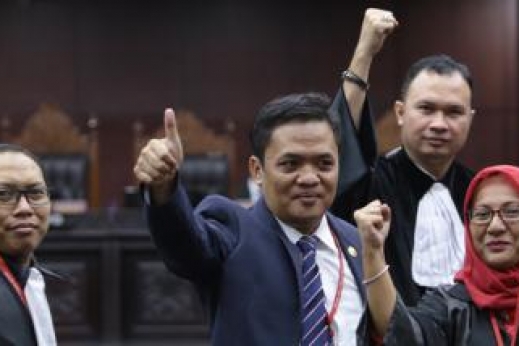
Habiburokhman as Principal Petitioner and his legal counsel after the preliminary hearing of the judicial review of the Electronic Information and Transactions (ITE Law) on Wednesday (4/10) in the Plenary Hall of the Constitutional Court Building. Photo by PR/Ganie.
The Constitutional Court (MK) held a hearing to review Law No. 11/2008 on Electronic Information and Transactionsas amended by Law No. 19/2016 on Electronic Information and Transactions (ITE Law) in the Plenary Hall of the Constitutional Court on Wednesday (4/10). The case No. 76/PUU-XV/2017 is filed by Habiburokhman, an advocate. The Petitioner requested for a judicial review of Article 28 paragraph (2) and Article 45A paragraph (2) of the ITE Law against Article 1 paragraph (3), Article 28D paragraph (1), Article 28E paragraph (3), and Article 28G paragraph (1) of the 1945 Constitution.
In the principal issue of his petition, through Ahmad Leksono, the Petitioner argues that the a quo articles violates his constitutional rights because they have the potential to be used as a tool to criminalize the Petitioner. This is because of a vague definition on the word antargolongan (\'intergroups\').
Article 28 paragraph (2) of the ITE Law reads, "Any person who knowingly and without authority disseminates information aimed at inflicting hatred or dissension on individuals and/or certain groups of community based on ethnic groups, religions, races, and intergroups (SARA)."
Article 45A paragraph (2) of the ITE Law reads, "Any person who intentionally and without authority disseminates information aimed at hatred or dissension on individuals and/or certain groups of community based on ethnic groups, religions, races, and intergroups (SARA) as referred to in Article 28 paragraph (2) shall be subject to 6 (six) years imprisonment and/or a maximum fine of Rp1,000,000,000.00 (one billion rupiah)."
According to the Petitioner, the term \'intergroups\' in the ITE Law has caused uncertainty. In its application, the articles can be interpreted very widely into any group existing in the community, both formal and informal. "Because of uncertain boundaries between groups as well as the uncertainty of why the intergroups identity is aligned and equated with the terms “ethnic groups, religions, and races” as regulated in the a quo articles," explained Ahmad accompanied by the Advokat Cinta Tanah Air (ACTA) team.
Ahmad also mentioned that the dissemination of electronic information that inflicts hatred based on ethnicity and race must be punished severely, i.e. over five years as regulated in the a quo article because ethnicity and race are two natural, inherent human identities. Hatred for both has a tremendous destruction power compared to hatred for personal reasons. This matter has been mentioned in Law No. 40/2008 on the Elimination of Racial and Ethnic Discrimination.
In line with that, Ahmad also stated that the religious identity must also be protected from dissemination of hatred-inducing information. "So, it is only natural that the dissemination of information that inflicts hatred based on religion must be severely punished," Ahmad asserted before the Constitutional Justice Suhartoyo as well as Constitutional Justices Manahan M. P. Sitompul and Saldi Isra.
Judges’ Advice
After hearing the Petitioner\'s explanation, Justice Suhartoyo gave some suggestions for revision of the petition. A suggestion is concerned with the petition principal that has not clarify the constitutional rights being violated by the enactment of the a quo article. In the petition, the Petitioner mentions concrete cases faced by others who are indicted by the ITE Law. Therefore, Justice Suhartoyo expected the Petitioner to further describe the constitutional damages he suffered by the enactment of the a quo article.
Justice Manahan also gave a note related to the Petitioner’s legal standing, as an advocate affiliated with ACTA. However, in his legal standing, the Petitioner has not yet confirmed his position within the organization. “The Petitioner’s legal standing in ACTA in what position? Because legal standing affects his constitutional damages as a citizen or as an official in the ACTA organization. This needs to be clarified," he said.
In addition, Justice Manahan also requested that the Petitioner strengthen his argument related to the impact of the a quo article against the Criminal Code (KUHP). "Substantively, two laws are challenged: the ITE Law and the Criminal Code. The Petitioner claims asynchronous interpretation. Thus, the argument is reinforced so that in the law there are two different interpretations of \'intergroups\' so that it would appear that the interpretation of ‘intergoups’ is the cause of the problem which resulted in the Petitioner\'s constitutional damages," said Justice Manahan.
Justice Saldi recommended that the Petitioner strengthen his legal standing with what he truly experienced. In addition, he expected the Petitioner to observe the Constitutional Court Decision Number 52/PUU-XI/2013 on ITE Law. " Article 28 paragraph (2) has been reviewed and decided by the Court in Decision Number 52/PUU-XI/2013. So, there should be an additional argument differentiating between this petition and the previous one. This is important," Justice Saldi suggested.
At the end of the hearing, Justice Suhartoyo said that the Petitioner was given time to revise the petition until Tuesday, October 17, 2017 at 10.00 a.m. (Sri Pujianti/LA/Yuniar Widiastuti)
Wednesday, October 04, 2017 | 18:32 WIB 256