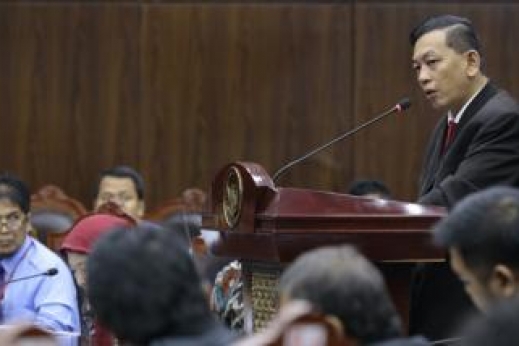
Abdul Chair Ramadan, an expert presented by the Petitioner delivering his expertise in the hearing of Ormas Law judicial review, Thursday (14/9) in the Plenary Hall of the Constitutional Court Building. Photo by PR/Ifa.
The Constitutional Court (MK) once again held a judicial review hearing of Government Regulation in Lieu of Law No. 2 of 2017 on the Amendment of Law Number 17 Year 2013 on Mass Organizations (Ormas Perppu) on Thursday (14/9) in the Plenary Hall of the Constitutional Court. The hearing was held for seven petitions, namely cases Number 38, 39, 41, 48, 49, 50, and 52/PUU-XV/2017.
The hearing was to hear the information of the Relevant Party and the two experts presented by the Secretary of Hizbut Tahrir Indonesia (HTI) Ismail Yusanto (Petitioner Number 39). The Petitioners argued that Article 59 Paragraph (4) letter c on the word “menganut” ("embrace"), Article 61 Paragraph (3), Article 62, Article 80, and Article 82A of the Ormas Perppu are against the 1945 Constitution.
State Constitutional Law expert Andi Irmanputra Sidin highlighted two constitutional issues related to the Ormas Perppu. First, the guarantee of legal certainty of the redefinition of the Ormas Law in the Ormas Perppu because the word “menganut” ("embrace") in Article 59 paragraph (4) letter c of the Ormas Perppu has a vast meaning and may be interpreted in different ways. Meanwhile, according to the expert, the Perppu should provide legal certainty to the community and meet the requirement of emergency, and is not rife with instruments of abuse of power.
"Then, the dialectics of society towards constitutional change will be threatened so the Perppu will not cause legal uncertainty. When that happens, the abuse of authority is coupled with uncertainty that spreads anxiety in society. Thus, the conditions that must be fulfilled by a Perppu are not fulfilled by the Ormas Perppu, meaning that this Perppu is unconstitutional," stated Irman before the Deputy Chief Justice Anwar Usman and other Constitutional Justices.
In addition, in his second elaboration, Irman highlighted the contrarius actus principle within the Ormas Perppu. He viewed that the Perppu could not be used as an excuse for state of emergency to immediately be realized in concrete rules. Therefore, Irman believed that the Ormas Perppu negated the role of the judiciary. This is evident in the dissolution of mass organizations without due process of justice.
Another expert, Abdul Chair Ramadhan explored a multi-interpretative provision of the Ormas Perppu. He observed that the multi-interpretation was related to the legality principle that had been violated by the Ormas Perppu. One of them is the application of the analogy in the elucidation to Article 59 paragraph (4) letter c in the phrase "... other doctrines aimed at replacing/changing Pancasila and the 1945 Constitution" on the dissolution of HTI. According to him, the provision equated doctrines that came from human thinking, namely atheism, communism, or Leninism and teachings derived from the legitimate religious teachings, such as HTI.
In addition, Abdul also gave an explanation on causal review because the Government became dominant in dissolving mass organizations or giving criminal sanctions to members of mass organizations considered to be against the Pancasila and the 1945 Constitution. In this case, he observed matters stipulated in Article 82A of the 1945 Constitution.
"If we simulate [it] with the causality approach, the most influential issue is blasphemy of religious teachings through the Ormas Perppu, because when a person believes in a religion or belief, it is certainly not a disgraceful thing to adhere to. Thus, there has been criminalization of legitimate religious teachings by the Ormas Perppu," Abdul, who is a Doctor of National Defense Law at Sebelas Maret University (UNS), explained.
Petitioners’ Legal Standing
On the same occasion, one of the Relevant Parties represented by Kores Tambunan said that the Petitioners did not have legal standing because the Petitioners as individual citizens did not explain his constitutional damages clearly. In this case, Kores asserted that individual constitutional damages suffered by a citizen could not be equalized with those of a legal entity affected by the Ormas Perppu being reviewed in the hearing.
"The Perppu applies universally, meaning that the state protects all citizens and, furthermore, the right to freedom of association and assembly constitutes the human rights of every Indonesian citizen. On that basis, Petitioner 39 who filed a petition as an individual Indonesian citizen who has individual rights cannot be equated with a legal entity or HTI that has been revoked by the Government on July 19, 2017," he said.
In relation to the Petitioner’s argument on the absence of state of emergency in the enactment of the Ormas Perppu, Kores stated that it was wrong and misguided. According to him, it is a form of authority of the President who is an executive power, which mentions the fulfillment of three state of emergency upon the issuance of a Perppu.
(Sri Pujianti/lul/Yuniar Widiastuti)
Friday, September 15, 2017 | 11:31 WIB 263