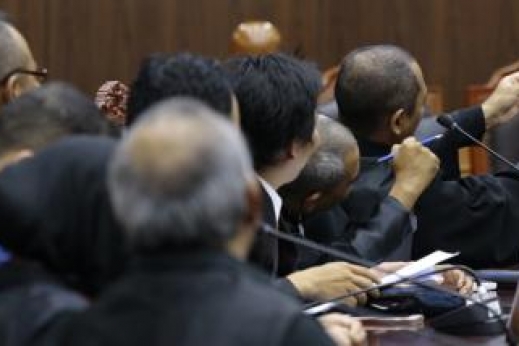
The Principal Petitioner was accompanied by his attorney attended the preliminary hearing on the case of Law on Mass Organizations on Wednesday (23/8) in the Plenary Hall of the Constitutional Court Building. Photo by PR/Ifa.
The Constitutional Court held the inaugural session of formal and material review of Government Regulation in Lieu of Law No. 2 of 2017 on Mass Organizations (Ormas Perppu), Wednesday (23/8). This time, the Petitioners are two advocates who are members of Advokat Cinta Tanah Air, Herdiansyah and Ali Hakim Lubis.
In a session led by Chief Justice of the Constitutional Court, Arief Hidayat, the Petitioner delivered a number of arguments of the petition. According to the Petitioner, currently there was no state of emergency in Indonesia that would compel the government to make a Perppu.
"The phrase ‘in a state of emergency’ according to the elucidation to the 1945 Constitution is the translation of noodverordeningsrecht, which can be interpreted as a rule of law to regulate the state of danger or emergency as stated in the elucidation to Article 22 of the 1945 Constitution," said Hendarsam Marantoko, one of the Petitioner’s attorneys.
In addition, according to the Petitioner, Ormas Perppu was contradictory to Article 28 and Article 28E paragraph (3) of the 1945 Constitution. The Petitioner felt the potential to lose their constitutional rights because their freedom of association and assembly was arbitrarily restricted.
The Petitioner assessed that the Ormas Perppu had created legal uncertainty and injustice. Injustice could be in the form of potential loss of opportunity for the Petitioners if they wanted to join a mass organization, when the Government did not accept the organization. The government may arbitrarily impose a dissolution on the mass organization, resulting in the loss of the right to equitably obtain equal opportunity in joining a mass organization.
Judges’ Advice
In response to the arguments presented by the Petitioner, Chief Justice of the Constitutional Court Arief Hidayat said that if the Petitioner wanted the Ormas Perppu to be completely revoked, they must elaborate the reasons why the articles in the Perppu were contrary to the Constitution. "So you can convince the Court to make a decision in accordance with what you expected," he said.
Meanwhile, Constitutional Justice I Dewa Gede Palguna suggested that the Petitioner further clarify his legal standing and constitutional damages, so that the Court could examine the petition. "In this petition, the Petitioner is an individual citizen, not a mass organization. One of the arguments put forward is that the right used as a basis for claiming constitutional damages is the right to freedom of association and guarantee of legal certainty. But I do not see any elaboration at all as to why it can be damaging. What is the relevance of the Ormas Perppu?" Palguna asked.
(Nano Tresna Arfana/lul/Yuniar Widiastuti)
Wednesday, August 23, 2017 | 18:48 WIB 197